
PersonAIble Review
Can Joshua Zamora's New AI App Really Replace a $1,000 Outreach Agency?
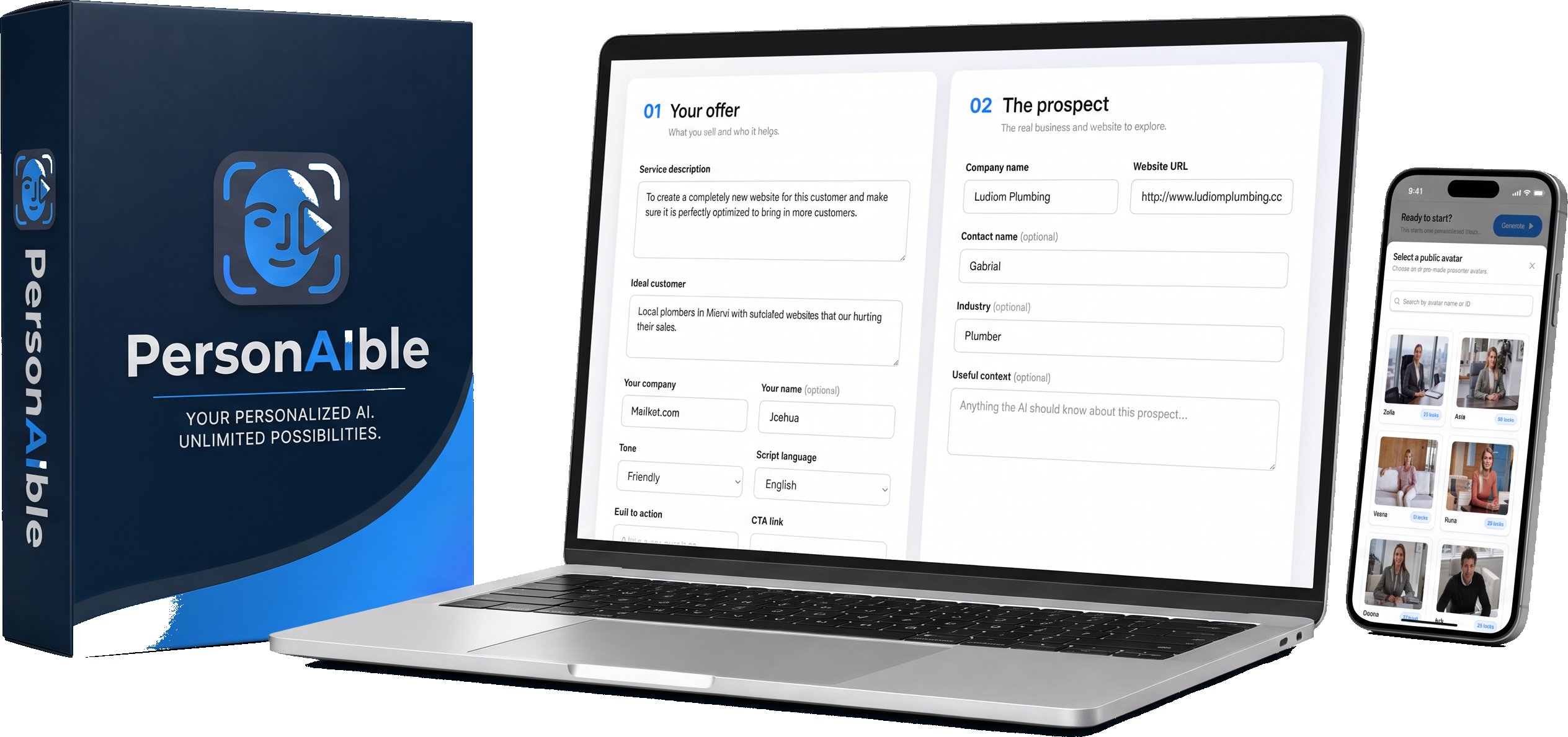
Cold outreach has a problem with response. Average sales email gets ignored. Average LinkedIn message gets skipped. And by the time a rep gets thirty seconds of a stranger's attention, half the working day is gone. That's the gap PersonAIble, a new launch from Joshua Zamora opening cart on September 10, 2026 via JVZoo aims to fill.
The pitch is straightforward: Instead of a generic message, PersonAIble crafts a 100% personalized video for every prospect, featuring an AI presenter reading a script over a live screen capture of that prospect's actual website, and then hands you a shareable link that's ready to go. In this PersonAIble review, we discuss what the software actually does, the cost once every upgrade is factored in, and how much of the pitch holds up once you strip away the marketing language.
Personaible Review - Inside The Member's Area
This is the member's area once you login.
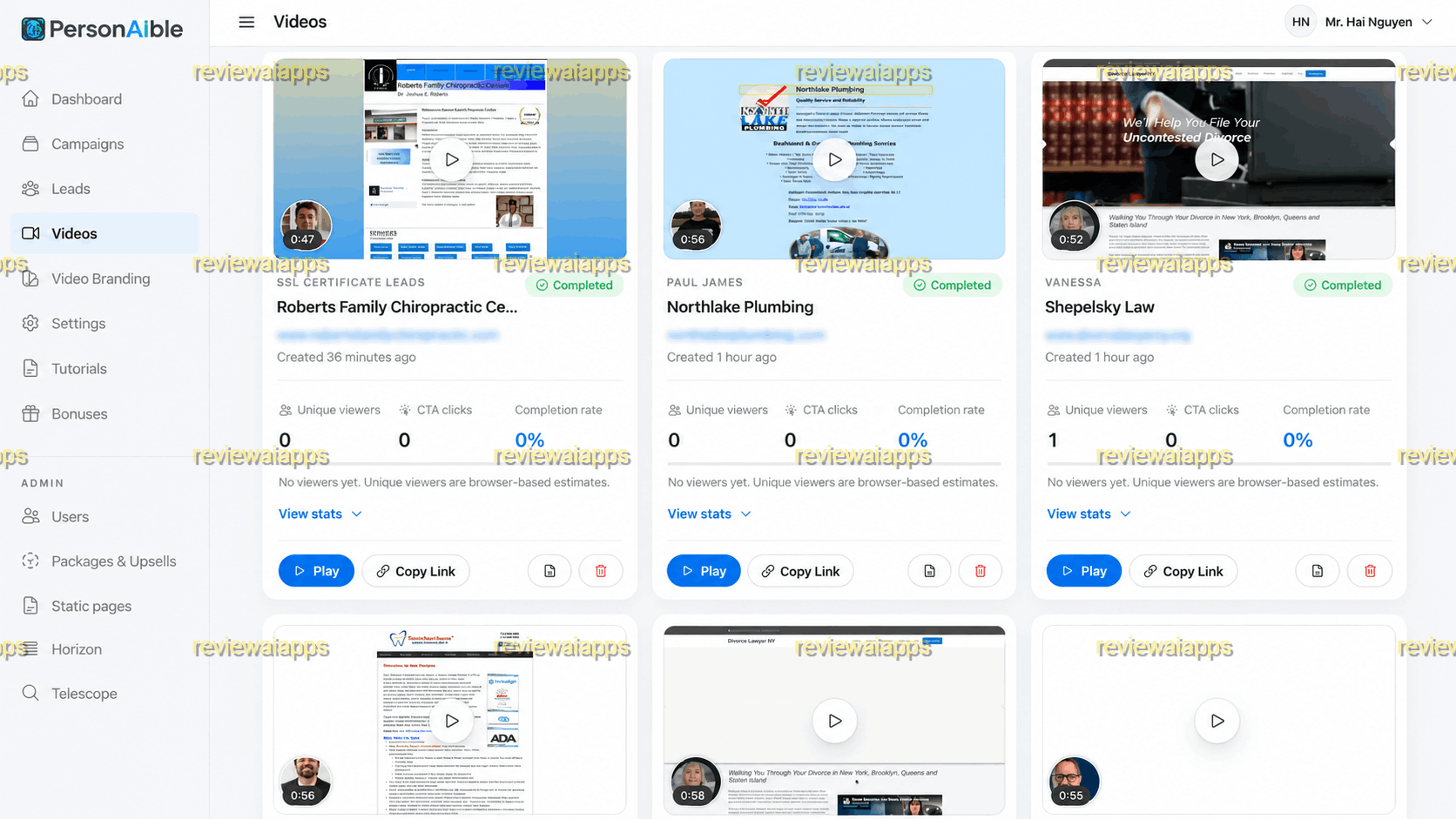
1. Video Creation
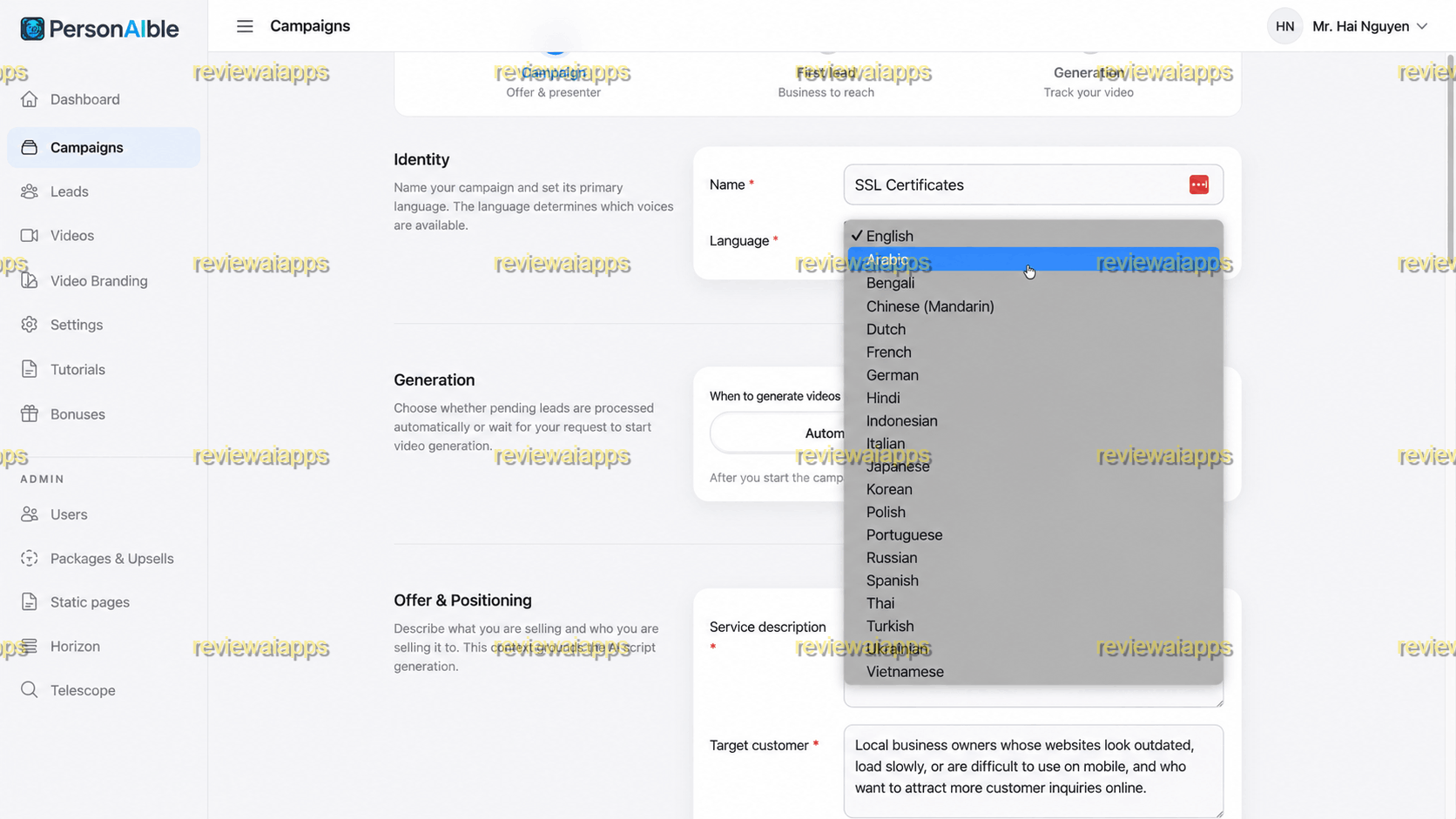
This is the first step, where as you do the campaign wizard before letting AI to generate a video for you.
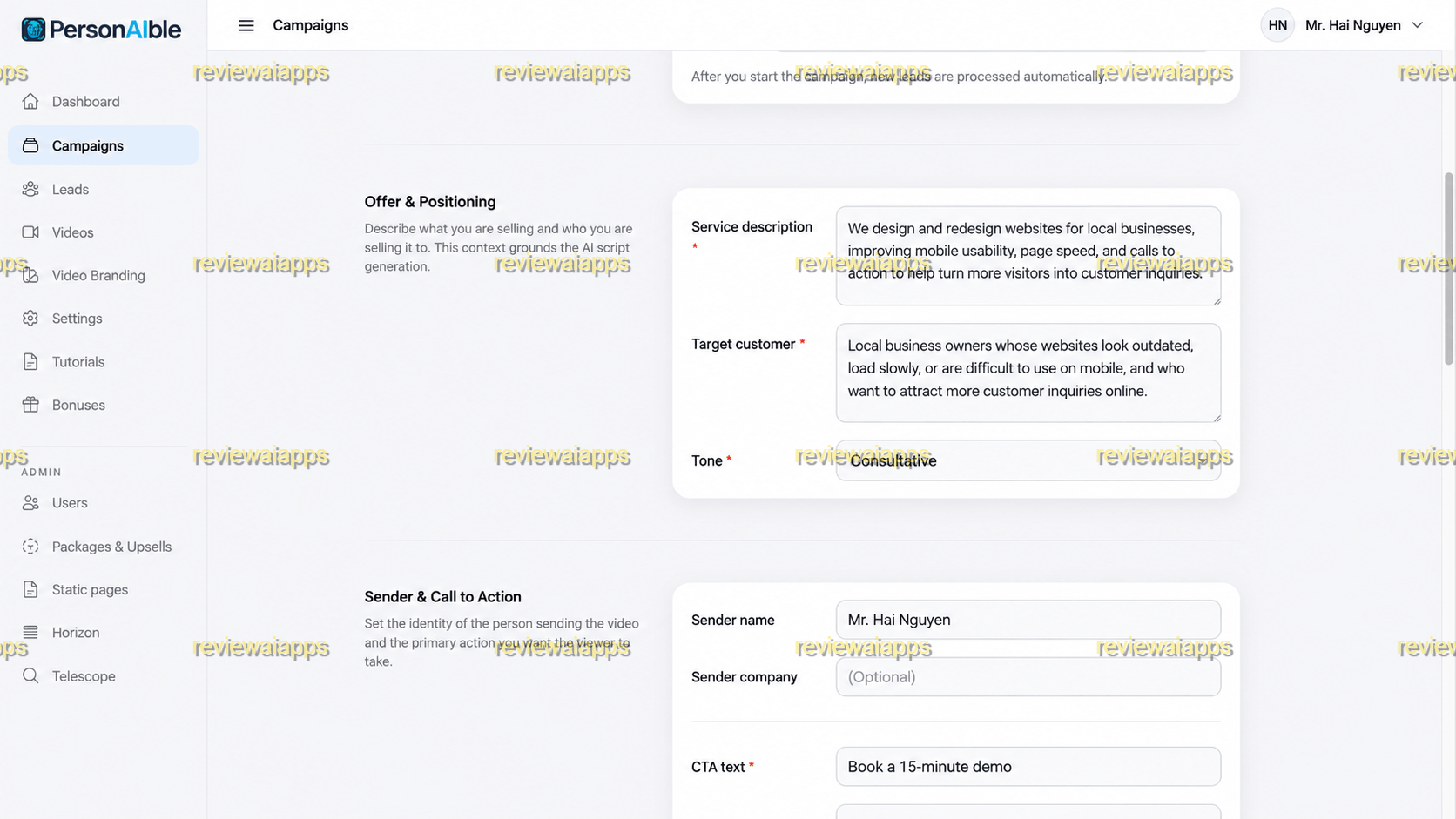
You have to define the service description, AI will not develop prompt for you.
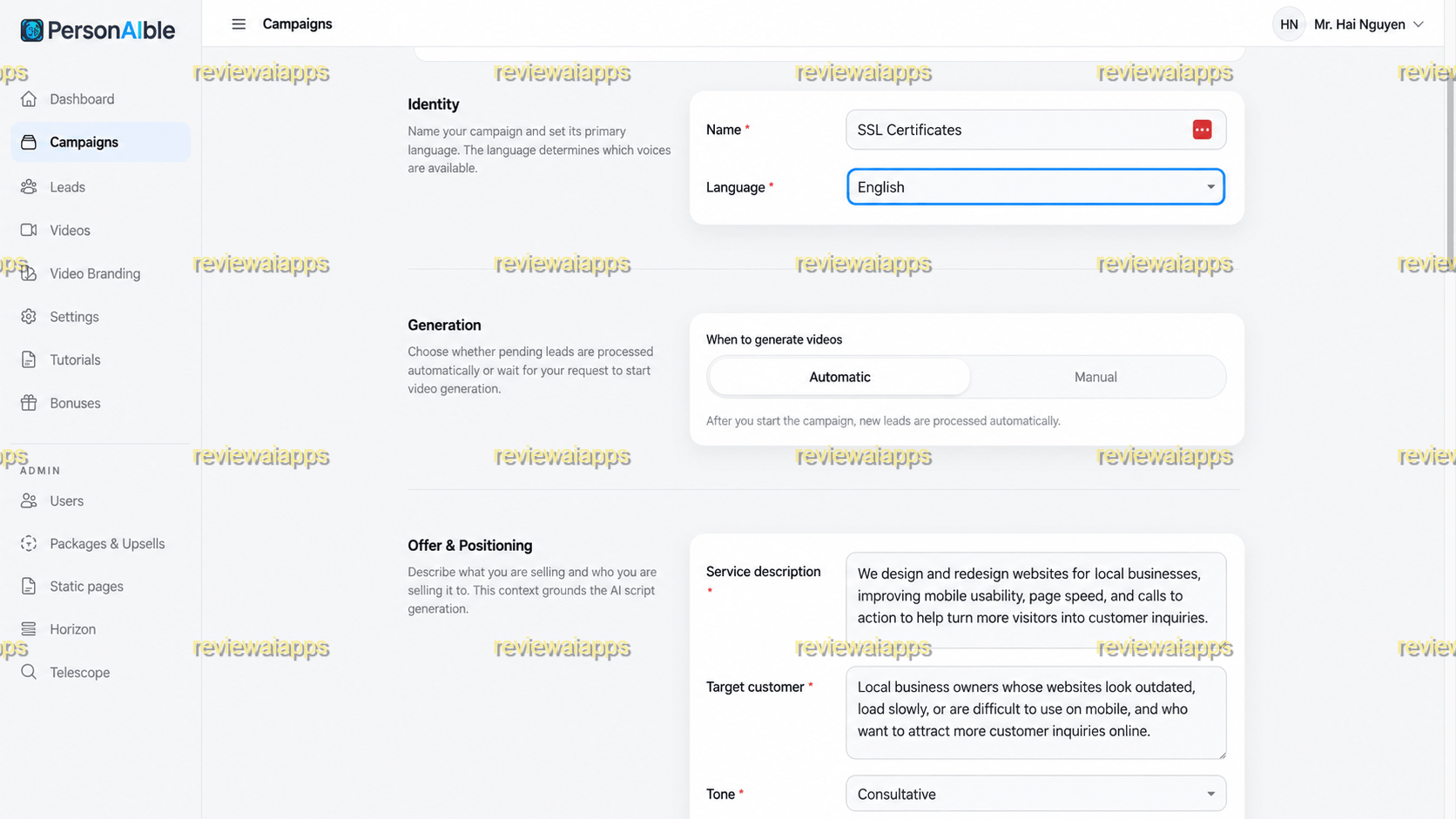
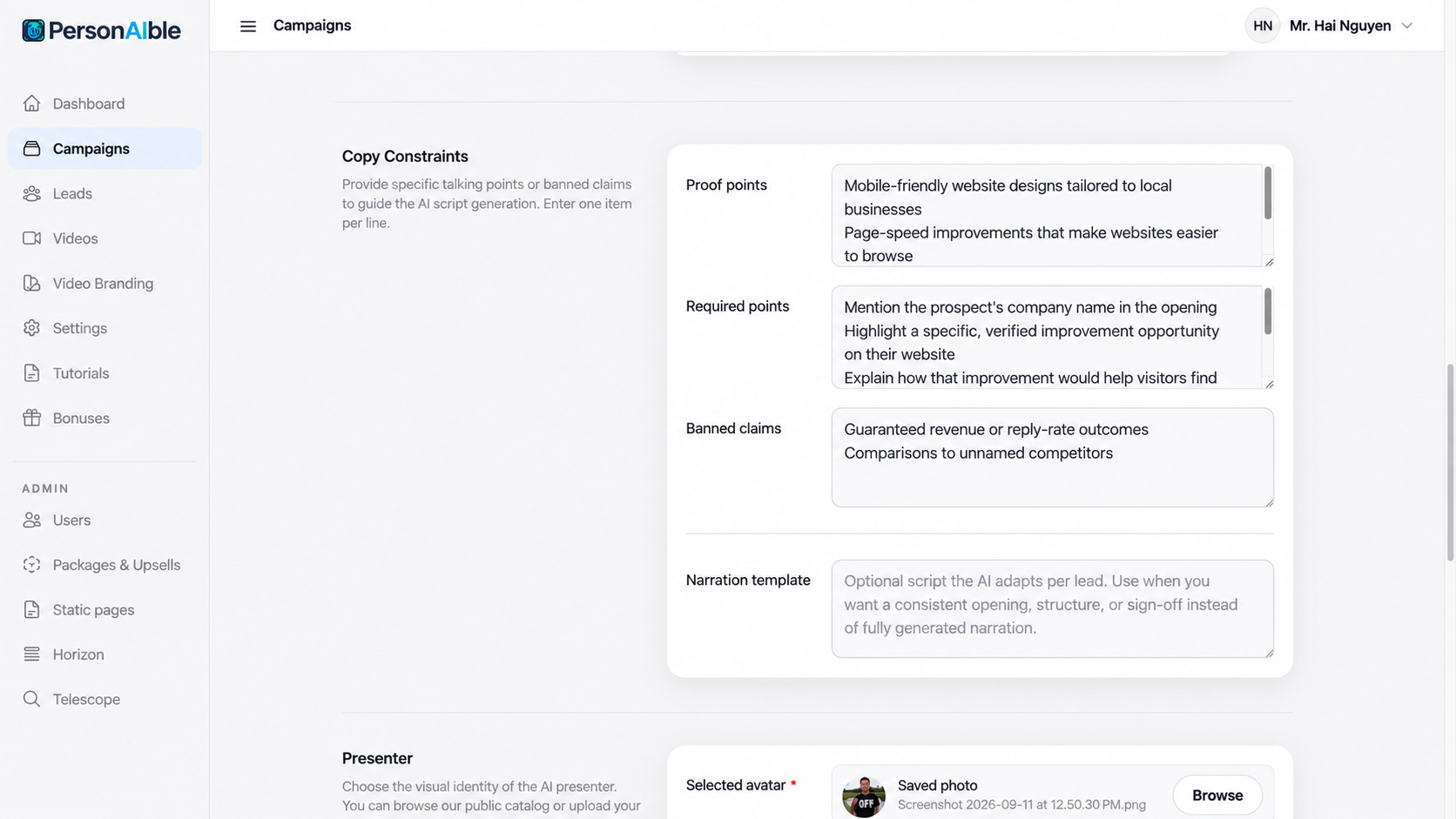
And you can see the copy constrains here, which is the basis to generate the new campaign.
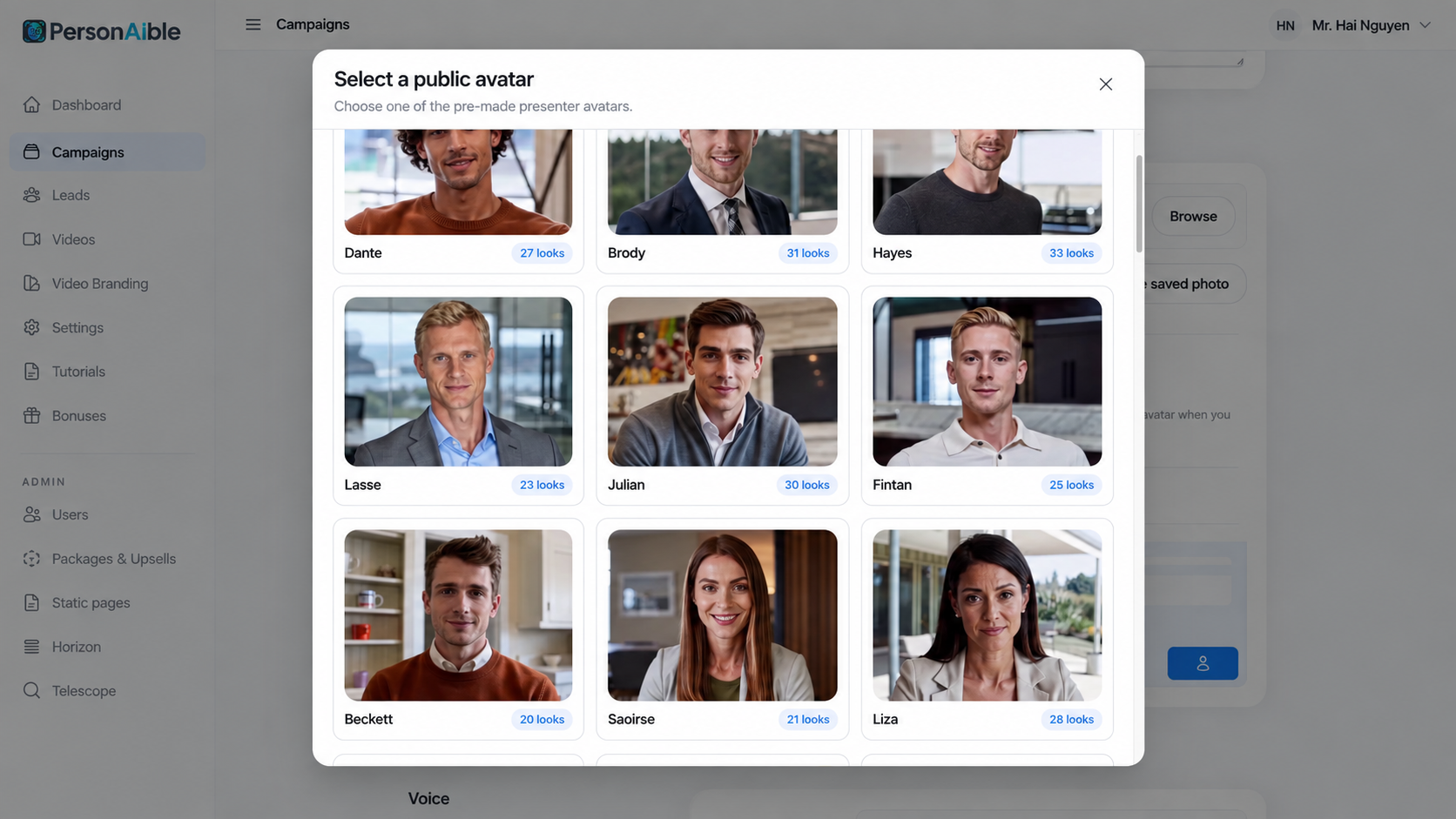
Then, choose a public avatar.
The Price Tag No One Starts With: Pricing and the Upgrade Path
The ad price is $34.95, but that's just the starting point for a longer series of upgrades, and it's worth walking through before anything else, because it makes what "PersonAIble" actually means as a purchase different.
| Product | Price | Type | What It Unlocks |
|---|---|---|---|
| PersonAIble Pro (Front End) | $34.95 | One-time | Core app, dashboard access, pre-loaded qualified leads, capped monthly videos |
| PersonAIble Unlimited (OTO1) | $47/month | Recurring | Removes the video and lead cap entirely |
| PersonAIble Actor Pack (OTO2) | $67 | One-time | Unlocks additional AI presenter looks |
| PersonAIble ReBrander (OTO3) | $47 | One-time | Custom domain, logo, and color scheme on generated pages |
| SerpSling AI (OTO4) | $47 | One-time | Companion SEO/marketing report tool (separate cross-sell) |
| PersonAIble Bundle | $247/year | One-time (annual) | Actor Pack + ReBrander + SerpSling AI bundled (excludes Unlimited) |
PersonAIble Pro — The Front End
The front-end product is called PersonAIble Pro, and it is a one-time payment of $34.95. This is the core app. Dashboard log in, pre-loaded set of qualified buyer leads and rights to use the tool for client work. The catch is that there is a limit to how many videos you can create per month at this tier, and that's where the first upgrade comes in.
PersonAIble Unlimited — OTO1
The first upsell is PersonAIble Unlimited, recurring at $47 per month. This eliminates the video and lead cap altogether, and functionally makes PersonAIble a subscription product rather than a one-time tool purchase. If you're testing it out instead of actually using this for any real client volume, you'll likely end up here either way no matter what the front-end price indicates.
PersonAIble Actor Pack — OTO2
The second upsell is the PersonAIble Actor Pack, a one-time $67 purchase to unlock more AI presenters. This is more important than it sounds. Without this, all customers on the base plan are using the same small set of default avatars, which breaks the "personalized" positioning as soon as two competitors in the same niche both use the same AI face in their outreach videos.
PersonAIble ReBrander — OTO3
The third upsell is PersonAIble ReBrander, a one-time $47 add-on that puts the buyer's own domain, logo and color scheme on the landing pages the tool creates. And without it, the shareable pages PersonAIble builds are automatically branded with the platform's own logo—a real problem if you want to present the output as coming from your own agency, not obviously outsourced software.
SerpSling AI — OTO4
The fourth upsell is SerpSling AI – a $47 one-time add-on that's only tangentially related to the core video tool. It markets itself as a companion generator to SEO and marketing reports, meant to turn a one-off video sale into a recurring SEO retainer with the same client. It's something that should be considered a separate product bolted onto the funnel, not a natural extension of PersonAIble itself.
The PersonAIble Bundle
For buyers who don't want to make four separate upsell decisions, there's a second option, the PersonAIble Bundle, at $247 a year (pricing is reportedly set to rise as the launch window progresses). This package comes with the Actor Pack, ReBrander, and SerpSling AI all at once in a single buy, with bundle-only bonuses too, but not the Unlimited subscription, which is a recurring choice in itself either way. That means, in practice, a full PersonAIble setup costs closer to $250-$600 in the first year, depending on the path you take, not the $34.95 headline figure.
How Does PersonAIble Work In Fact
Inside, PersonAIble makes video outreach as easy as four steps. First, no install or configure needed – user gets instant dashboard access after checkout. Second, they select a lead from a pre-qualified prospect list already loaded into the account, each tied to a documented business problem, supposedly. Third, it's a one-button-click to create the video. The software writes the script, generates a photorealistic AI presenter with lip sync audio, and overlays a live screencast of the prospect's actual website, all automatically tied together. Fourth, the final output is rolled up into a shareable branded landing page with a call to action button that's ready to send directly to the prospect.
It's more than just a raw video file. Each project provides a hosted page so that the deliverable sent to a prospect looks like a small, purpose-built micro-site, not an attachment. That one design choice is doing a lot of the actual selling for the product: a live screen capture of one's own website, narrated by a presenter who names their business by name, reads as considerably more custom than a templated video ever could, even if the underlying process is fully automated on PersonAIble's side.
The pre-qualified lead list is itself worth a closer look, as it's one of the more unique aspects of the offer. The dashboard is said to come pre-loaded with businesses that have a documented problem PersonAIble's pitch can speak to, rather than having the buyer scrape or research prospects themselves. It removes what is typically the slowest part of any outreach campaign, finding a list worth reaching out to in the first place, and it's also the part of the funnel that is hardest for an outside reviewer to verify independently, as lead quality only becomes apparent once a buyer is inside the dashboard testing real send rates. If the language of "pre-qualified" proves to be reliable, consider it a useful convenience and the one thing most important to stress-test personally before building an outreach volume strategy around it.
The Real Promise of PersonAIble
Remove the launch-page language and the core promise is a time trade. Agencies that already offer this kind of personalized video outreach as a service are said to charge anywhere from $1,000 to $3,000 per engagement, and building even a single one of these videos manually, researching a prospect, writing a script, recording, and editing, tends to eat up two to three hours. PersonAIble's pitch is that it boils that process down to a single click, which is the entire premise of the "done-for-you" framing that permeates the page.
And the other value propositions are who gets to use this, apart from the pure time savings. If anyone is uncomfortable about being on camera themselves they are given an AI presenter as a substitute. Once you are on the upper tiers, anyone trying to climb past one prospect at a time gets, in theory, unlimited output compared to a one-to-one bottleneck. And anyone who runs or wants to run an agency is steered toward reselling these videos to their own clients and keeping the full fee. The prequalified lead list is included specifically to take the prospecting step out of that equation.
It's worth a second look at the agency-resale framing, because it's doing more work in the pitch than one line suggests. Selling personalized video outreach as a client service is not a new business model; agencies already charge the $1,000 to $3,000 figure the page cites for exactly this kind of work, so the real question for a buyer is not whether the service is sellable, it clearly already is in the market, but whether a $34.95 to low-hundreds software purchase is enough to produce output that holds up against agencies charging that much because a human is involved in strategy, targeting and follow-up, not just the video file itself. PersonAIble automates the production step convincingly: it does not automate the sales relationship around it, and that's where a buyer's own effort still has to show up.
The Scientific Basis for the Throw
The page uses a lot of third-party research to make the case for video outreach in general, and it's worth noting that this is not the same thing as making claims about the product itself. The statistics quoted (Sales emails with video get a 26 percent lift in replies (Salesloft), 85 percent of people say they've been convinced to buy by watching a video (Wyzowl), personalized calls-to-action convert 202 percent better (HubSpot), and reps who lead with video see reply rates about five times higher (Vidyard) are real, published results from recognizable research companies. Other credible data points from McKinsey, Salesforce, etc. include video ROI, buyer expectations on personalization, and format preference over cold calls or articles.
What those numbers really prove is that personalized video outreach, as a category, outperforms generic text-based prospecting. None of the cited studies were done using PersonAIble, so they say nothing directly about its specific output quality, deliverability or conversion rate. The stats are right, the unproved work is the implication that they carry directly onto the results of this particular product.
One figure in particular is worth spending time with. That same body of research cited on the page notes that about 65 percent of viewers will watch a video under one minute all the way through, which is really more a statement about attention span than persuasion—the shorter and tighter the video, the more of it actually gets seen. That detail is a double-edged sword for PersonAIble: it's a point in favor of automated, quickly generated videos over painstakingly produced ones, but it also means the AI presenter's script and delivery need to be able to hold attention on their own merits, because no amount of favorable industry-wide data can rescue a specific video that loses its viewer in the first twenty seconds. The research supports a video strategy; it does not and cannot vouch for the quality of execution of the output of any one tool.
Where the Claims Start to Thin
There are a few specific claims on the page that are worth flagging for their own reasons, outside of the general research citations. PersonAIble is described on the page as the "first and only done-for-you app of its kind," a bold claim in a market that already includes several AI avatar and personalized-video-prospecting tools built around a similar core mechanic, from AI UGC avatar generators to existing video-prospecting platforms that already combine a talking presenter with prospect-specific context. The page itself does not indicate whether PersonAIble's specific implementation is better, worse, or simply different from the existing field, and "first and only" is the sort of line that sounds more like standard launch copy than a claim that would hold up under a direct apples-to-apples comparison.
Even more important is the claim of a payment range of $500 to $1,000 per video delivered. There is no named client, case study or verifiable transaction attached to this figure on the page. It's an instance of what can be, it's not a documented result, and it should be read like that, not like a guarantyd result of purchasing the software. If you've purchased this type of product before, the scenario will be familiar: an explanation that sounds plausible, but without the receipts to support it.
Also worth saying plainly, there is no refund policy or any kind of performance guaranty on the page. That's not unusual for a launch in this space but it does mean that the full financial risk of the $34.95 entry purchase and everything layered on top of that is on the buyer from the first transaction.
Who Is PersonAIble For?
When you look at the funnel and feature set together, it's clear PersonAIble is targeting two overlapping groups, not the same buyer type. The first is someone who's already doing cold outreach, sales development reps, freelance closers, small business owners prospecting for their own company, who wants a fast way to stand out in a crowded inbox without learning video editing or hiring a videographer. For that group, perhaps the front-end product alone is sufficient, as the core loop of selecting a lead and creating a video doesn't necessarily need any of the 4 upgrades to work.
The second group is the one that the page spends more time courting: people looking to package this up as an agency offering and resell finished videos to their own clients. That's the group where the upgrade path stops being optional. That's a harder sell than marketing suggests: presenting a client-facing deliverable with the platform's own branding and a stock AI presenter that other buyers are also using. That's exactly why ReBrander and the Actor Pack exist as upsells rather than baked into the base price. Anyone thinking of PersonAIble as an agency income idea should be pricing in the Actor Pack and ReBrander from the start, not as optional extras to look at later.
Launch Time and Structure
PersonAIble's cart opens on September 10, 2026 at 11 AM ET and closes on September 14 at midnight PT. This is a typical five-day launch window for a product on JVZoo. The page also references a two-phase promotional structure associated with that window, though the mechanics of that structure are outside the scope of what this review discusses, considering that the focus here is the product itself, not the way it is being marketed to promoters. The important thing is that pricing, bonuses and availability on some of the upsells may change once the launch window closes which is common for this type of release and not specific to PersonAIble.
Who Is Behind PersonAIble
The page says Joshua Zamora is the creator of PersonAIble, and has a branded photo next to it, but there is no further background, track record or credentials associated with that name. There's no origin story, no mention of previous product history, no third-party validation of experience on the page itself. That's worth knowing going in: buyers deciding whether to trust this launch are working from the product description and the surrounding marketing rather than an established, independently verifiable vendor history laid out on the page.
The Bottom Line
PersonAIble is built on a really reasonable premise. Outside research strongly supports that personalized video is a better performer than generic outreach, and a sensible, technically feasible way to automate that personalization at scale is to partner an AI presenter with a live screencast of a prospect's own website. The upgrade path is also more coherent than your average bolt-on upsell sequence. Unlimited solves a real usage cap, ReBrander solves a real branding problem, and the Actor Pack solves the real problem of every customer defaulting to the same AI face.
Where this PersonAIble review gets more cautious is on the specific promises stacked on top of that basis. The "first and only" positioning overstates the novelty of the category, the per-video income figures are presented without any evidence to back them up and there's no refund or guaranty to fall back on if the results don't live up to the pitch. That doesn't mean the underlying tool is implausible, but it does mean the honest way to approach this launch is as an unproven, aggressively marketed product built on a sound idea, rather than a guarantyd income method. If you're considering the $34.95 entry price, understand right away that the real cost of a fully equipped setup is several times higher once you add Unlimited, the Actor Pack and ReBrander, and that every income figure attached to it is, for now, a projection and not a documented result.

🎁 VISIT MY BONUS PAGE 🎯
Comments
Join the discussionNo comments yet. Be the first to comment.