
ProductsPilot Review
What This AI Digital Product Tool Actually Does (And Where It Falls Short)
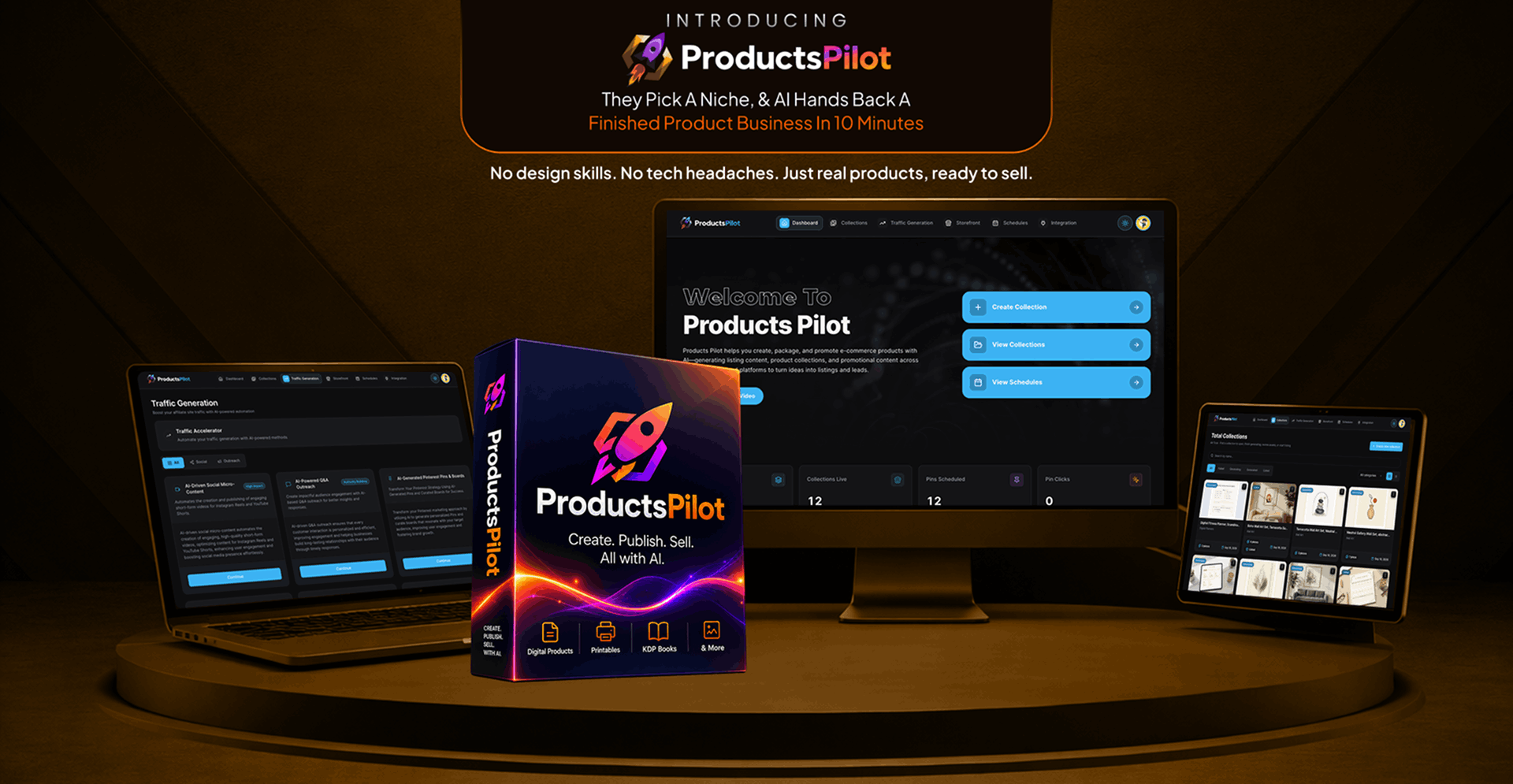
Printable planners, wall art, invitations, worksheets and low-content books have quietly become one of the most stable corners of the digital economy. Millions of buyers download this sort of thing every year, sellers never run out of stock, there is nothing to ship, and the whole business lives inside a folder of files. But it's always the same catch: Someone still has to come up with the design, write the listing, and figure out how to get eyes on it. The new launch from software vendor Abhi Dwivedi, ProductsPilot, is built around removing that catch. The concept is simple in theory. Choose a niche, choose a look, and an AI pipeline creates a complete product set that's ready to sell, writes the listing, and drives traffic to it.
That's a big promise, and this ProductsPilot review is here to separate what the tool actually does from what the sales copy claims to do. Before you drop a dime on it, I walked through the pricing structure, the real workflow inside the app, the storefront and traffic tools, the vendor's track record, so you can decide whether it earns a spot in your toolkit.
ProductsPilot Pricing and Upsell Path
ProductPilot's front end will launch at $37 during the earlybird window, and increase in increments throughout launch week, so the price you see on day one isn't the price you will see on day five. There are no coupon codes for this one, the early price is the discount. The front end includes all four of the tool's core AI agents, eight product types (wall art, planners, digital planners, templates, invitations, kids and education material, reports and guides, and craft files), a limit of 15 finished products a month, and two connected storefronts to publish through.
From here, ProductsPilot gives buyers two different ways to expand what they own, and it's worth understanding both of them before you buy anything.
The a la carte way is the front end: buy the front end, then decide on each upgrade as it is offered, skipping anything you do not want.
Immediately after purchasing the front end, you are offered FastPass for $230 a year. FastPass is the all-in-one option: it bundles all four of the upgrades below into one purchase, plus three bonus app licenses and the full set of training and bonuses, so buyers that already know they want everything can get it in one step rather than four separate ones.
If you don't use FastPass, then the upgrades are presented one at a time and each is totally optional.
Unlimited costs $67 a year and removes the 15-product monthly limit completely. It also unlocks a faster generation engine, bulk creation and API access for anyone who wants to plug ProductsPilot into their own workflow.
Diamond Storefront costs $97 per year, and gets you your own branded store, with buyer capture built in. This is for sellers who want to build their own audience, and not just rely on marketplace traffic.
Platinum Agency is a one-time $97 fee that opens up 25 shop slots, white-label branding, client-facing reports, and multi-user team access, obviously built for anyone planning to run this as a service for other people versus just for themselves.
The Elite Marketplace Multiplier is $67 per year and it does two things. It unlocks the ninth product category for KDP style low content books and it adds several more marketplace connections beyond the two that are included with the front end.
There's also a Gold DFY Vault – that's a library of 500 ready-made, done-for-you products for $197. This one is only available to buyers who have already picked up FastPass or buy through the Bundle or Lifetime options below. If you skip FastPass and never touch the Bundle path you will not be offered the Vault at all.
Option 2 is the Bundle path, for buyers who already know they want most of what ProductsPilot has to offer, and would rather buy it in one purchase rather than click through the front end and each upgrade individually.
The Bundle Deal is $317 for the year and it includes the front end plus all four of the upgrades listed above, plus the full training and bonus package, all in one transaction. It does not include the Gold DFY Vault, which is still available separately.
If you're not interested in being locked into an annual fee, you can also buy a Lifetime Bundle for $497. It is a one-time payment that includes the same range as the Bundle Deal, but without ever renewing.
Both the Bundle path and the Lifetime path continue after an optional $77 order bump at checkout, as well as the Gold DFY Vault which is offered separately.
ProductsPilot supports its front end with a 14-day guaranty on every path, a shorter window than many competitors but enough time to test the core generation and listing workflow before further investment. One pricing note to make clear: this one-time and annual pricing structure is specific to the launch window. The cart closes and ProductsPilot goes to an ongoing monthly subscription model, so the value of the low upfront cost is tied to buying during launch week, not something that's available indefinitely.
How ProductsPilot Works
Strip away the marketing-speak and the real workflow inside ProductsPilot goes through five stages: Niche, Style, Generate, Review and List/Publish.
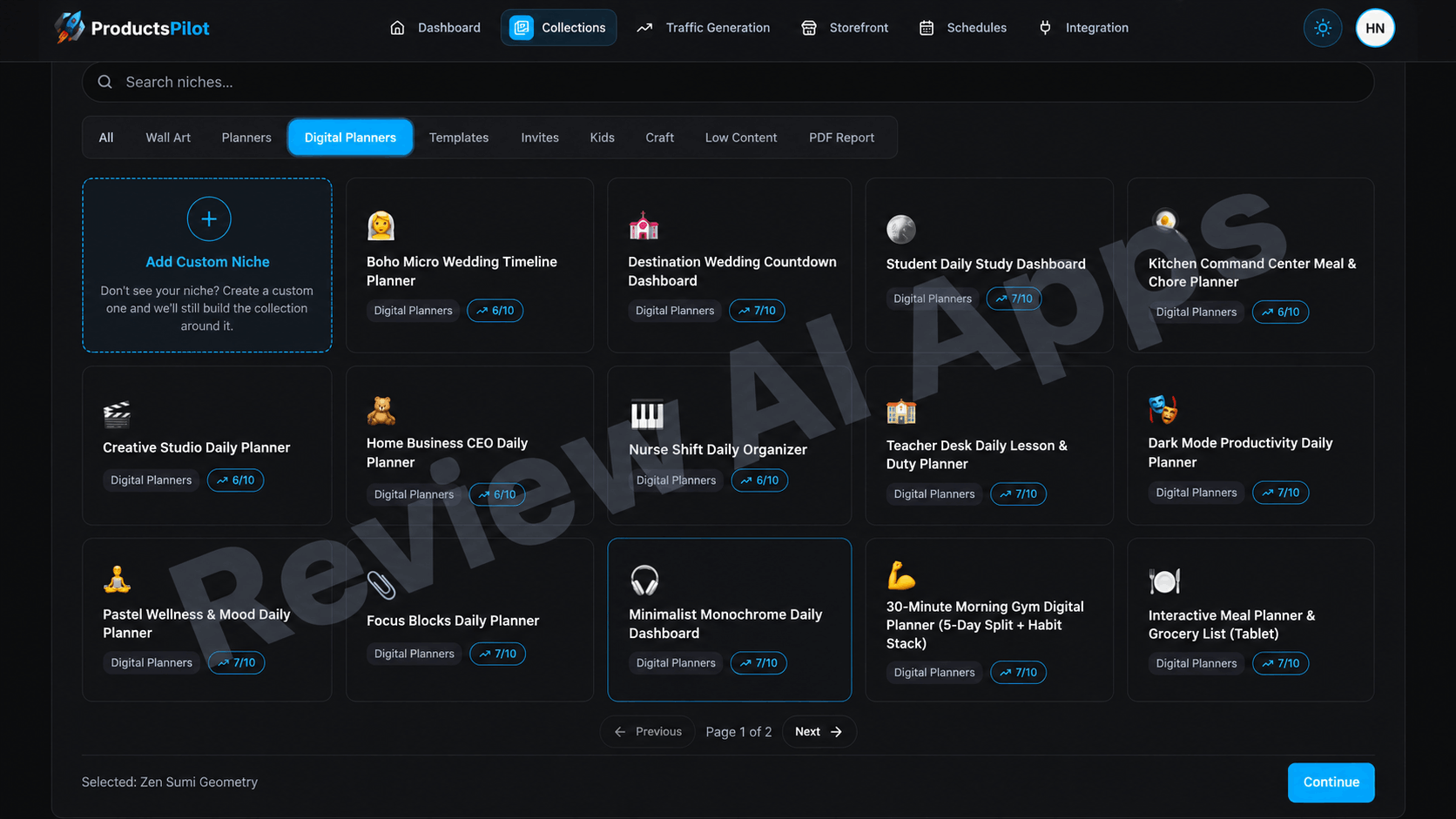
The Niche step opens up to a searchable grid of niche suggestions, each tagged with a category and a demand score out of ten.
In practice, the scores I saw ranged from moderate to fairly repetitive (mostly sixes and sevens rather than glowing numbers across the board), and a good number of the suggested niche names followed a fairly repetitive formula, things like a profession or activity paired with "daily planner." That's not necessarily a problem, since a solid starting list beats a blank page, but it is worth treating the suggestions as a starting point to sanity-check yourself rather than a guarantyd winner just because the tool ranked it.
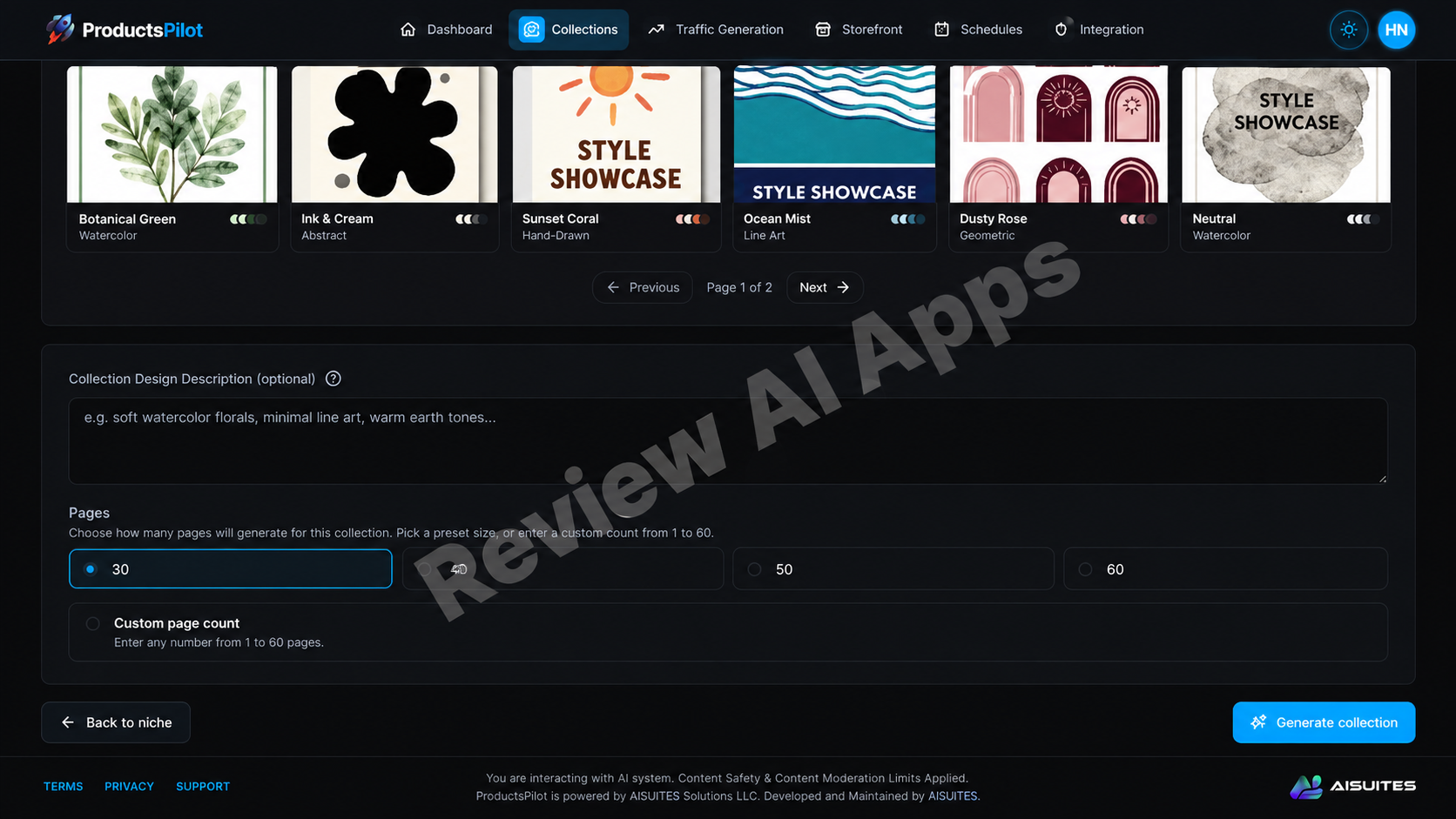
In the Style step, you'll see a gallery of pre-built esthetics, from watercolor and terrazzo patterns to mid-century and retro looks, each with a short description of the style. Here's what you can do: You can do free-text art directing yourself before generating. One thing to note if you're near launch day: part of the style gallery I viewed still had generic placeholder art instead of final preview thumbnails, so some visual polish may be playing catch-up even as the product goes live.
Once you select a niche and style, Generate begins as a background job so you don't have to sit there waiting. Just leave the app and come back when it's complete. The output is not a single image, but a full matching set of files at print resolution (with mockups composited in). The overall number of individual pieces in a finished collection varies quite a bit depending on which niche and category you choose. A digital planner collection I looked at came out to five pieces, while the style-selection screen also offers longer 30, 40, 50 or custom-length collections up to 60 pages for other product types. Before you assume all your collections will be the larger size, it is worth making a sample in your target niche.
In the Review step, you can review the finished pieces and create lifestyle mockups for a selected design before moving forward. Mockup creation is a manual process, generating one design at a time rather than automatically running through every item in a collection. Therefore, if you want mockups for the entire set, be prepared for a few additional clicks.
List/Publish is the step that buyers need to understand clearly before they assume this is a fully automated process. ProductsPilot walks you through a 10-step checklist for each marketplace connection: download your images in sequence, create and copy a title, description, tags and category, fill out Etsy's required AI-generated-content disclosure, set your price, then publish the listing yourself on the marketplace in a different browser tab before pasting the live listing URL back in to complete the step. It is honest about this in its own interface, bluntly saying it does not open or control that other tab for you. Gumroad seemed to tie in to publishing more directly than Etsy, and Printify and Shopify are also options that pop up in the dashboard as marketplaces, although I wasn't able to confirm just how hands-off publishing to those two is. The bottom line: ProductsPilot does a good job of generating your assets and preparing your listing content, but getting that listing live on a marketplace, and especially Etsy, still takes real manual effort on your part.
Core Features And What You Really Get
In addition to the five-step workflow, there are a few features worth mentioning on their own.
ProductsPilot is a hosted storefront builder that offers more than a simple landing page. There are five ready-made template styles, built around different esthetics ranging from a minimal atelier look to a high-energy streetwear layout. There are six preset color palettes, and separate controls for heading and body fonts, all with a live preview as you customize. It acts as a separate branded shop you can send traffic to, separate from what you list on Etsy or Gumroad.
On the traffic side, we have an AI-driven short form video tool, built specifically for Instagram Reels and YouTube Shorts. Choose a collection to promote, select up to four product images plus an optional character image, select a country and language, choose from a real set of named AI voices or plug in ElevenLabs or a cloned voice, choose background music, and select a 9:16 or 16:9 aspect ratio before generating the video. It is one of the more genuinely built-out parts of the tool, though worth noting that what I saw covered video generation clearly. Whether the finished videos post automatically to your social accounts afterward versus needing to be downloaded and posted manually is something to confirm directly once you have hands-on access.
On the licensing side, buyers receive full commercial rights to sell what they generate. Each listing that the tool prepares has standard personal-use language for your own customers, covering the usual points about digital delivery, no resale of the source files and normal variation in printed colors. This is a sensible, standard setup for a print-on-demand style business and is very much in line with the way that most digital product sellers already operate.
Who Is ProductsPilot Really For
Given the workflow and upgrade structure, ProductsPilot is especially well suited to a few types of buyer.
The most obvious advantage is for people new to the scene who want to start selling Etsy-like digital products but don't have a design background. The tool eliminates the biggest barrier to getting started: having to produce something that looks finished.
Current Etsy, print-on-demand or digital download sellers can use it to add volume to a shop they already run, without adding hours of design work to their week.
The Platinum Agency tier is a no-brainer for anyone wanting to offer this as a service to other sellers or run multiple shops for clients and the Elite Marketplace Multiplier tier is for sellers who specifically want to expand into KDP low-content books.
It's a softer fit if you're expecting a fully passive system, as real ongoing effort is still required at the listing and marketing stage regardless of which pricing tier you buy into.
Vendor of ProductsPilot
ProductsPilot is the brainchild of Abhi Dwivedi and VineaSX Solutions LLC, a vendor with a long history of launching digital products and software, including an earlier release in 2026, ContentClaw, just a couple of months before this one. Such a rapid release cadence is typical of this niche and not necessarily an automatic red flag, but it's a fair data point when thinking about how much ongoing attention any one product is probably going to get once the launch buzz subsides and the next release takes its place. It's also worth knowing that the app itself runs on a platform called AISuites, which its own footer credits to a separate development and maintenance company instead of saying it's built entirely in-house. That doesn't change what the tool can do today, but it's something reasonable to consider if you are weighing up how much long term support and updates to expect.
Where ProductsPilot Misses
ProductsPilot does work on the generation side, and that's worth saying straight out before getting into the criticism. But there are some things that don't quite match the polished, fully automated picture that the marketing paints and buyers deserve to know them upfront.
The biggest hole is publishing. The pitch suggests a product that goes from idea to a live, buyable listing in one sitting, and that is not true for Etsy. Getting one finished collection onto Etsy is not a one click, it is a real, multi-step manual process on your part. If you plan to sell mostly on Etsy, allow for the listing side of this, not just the design side, in your budget real time.
There were a few rough edges in the storefront and app, indicating that polish was still catching up close to the scheduled launch.
Some of the style gallery showed placeholder art instead of finished previews.
One sample storefront I looked at had glowing customer testimonials even when there was no real purchase history behind it, which is worth flagging for anyone using the storefront template as-is: replace the fake reviews with real ones once you have them instead of leaving fake social proof live, both for honesty with your own customers and because marketplaces generally won't look kindly on fake reviews.
That sample storefront also had a broken product filter page that returned no results even when real products were listed. It's worth testing your own storefront setup carefully before sending traffic to it.
While the niche suggestions are good to use as a starting point, they tend to have a moderate demand score and a very repetitive naming pattern. They do not always point to a winning niche, so treat them as a shortlist to validate.
And, finally, keep in mind the pricing above is a launch week pricing structure. But after cart close, ProductsPilot continues on an ongoing monthly charge, so the value calculation looks different for someone who buys later vs. someone who buys during the launch window itself.
Final Verdict: Should You Go For ProductsPilot?
On the creative side, ProductsPilot does what it says. It truly builds complete, print-ready digital product sets from a niche and style pick, with real mockups, a real hosted storefront you can customize, and a real AI video tool for social promotion. This is a real time saver for anyone who's wanted to sell digital products, but has never had the design skills to make something that looks finished.
Where it fails the pitch is in the framing of "hands free, done in minutes." It still takes real manual labor to get a product live and selling, especially on Etsy, and a few corners of the app and storefront weren't completely polished in the lead-up to launch. If you expect a tool that creates strong starting assets and a usable storefront and you are willing to do your own listing and marketing legwork, then the $37 front end is a reasonable, low-risk way to try it, especially within the 14-day guaranty window. Much more logical for higher tier upgrade packages, especially the Platinum Agency and Bundle options if you know you want to run this at scale and/or across multiple shops and not a first purchase for someone just dipping their toes in. Buy it for what it is: a strong content and asset generator with a real storefront attached, not a fully automated income system. It's a reasonable tool for the right kind of seller.