

PodShorts is an AI app that turns whatever topic you type into a full podcast show, then automatically chops that show up into short vertical videos and posts them to TikTok, Instagram and YouTube Shorts. Launches 25 August 2026 - 11:00 AM ET Cart Closes 31 August 2026 - 11:59 PM PT
The product is created by Abhi Dwivedi via VineaSX Solutions LLC and sold on JVZoo. The front end is 37 dollars, it's a one time payment.
$317 → $267 — you save $50
What is PodShorts really
The best way to understand PodShorts is to be honest regarding the category because the name is misleading.
This is not a podcast tool. It generates a podcast that nobody's supposed to listen to. The show is AI-generated, a production input, it exists to be sliced into fifteen short clips pushed into the video feeds, where the real objective is a click on a monetized link.
If you look at it that way, it makes sense. PodShorts is a system for mass short-form video production and posting with the raw material being a two-host conversation. That's a smart format, too; talking-head podcast clips are gaining good traction on social feeds these days and feel more natural than slideshows or stock-footage voiceovers.
The promise is the removal of all production barriers at once: no microphone, no co-host, no camera, no editing software, no scheduling tool and no existing audience.
The Seven A.I. Agents
PodShorts is structured around seven modules, each solving a job that would otherwise require a separate person or tool.
TrendRadar analyzes podcast charts and social feeds to find what's trending in a niche and scores them by momentum.
CastStudio builds the on-screen talent, either cloning your own face and voice or selecting from a ready-made AI persona.
ShowForge writes and voices the episode, typically 3-10 minutes with two speakers alternating.
ShowForge has three angles per topic.
ClipGenie breaks down an episode into up to 15 vertical clips, adds hooks and captions to each and gives it a score to show how it might perform.
The Variation Engine creates a platform-unique version of each post, swapping out captions, hooks and visuals between accounts.
AutoCast publishes and schedules to TikTok, Instagram and YouTube Shorts on a staggered drip schedule.
ProfitRouter attaches a monetized link page to each channel, rotates affiliate offers and tracks clicks.
PodShorts Review - Inside the Member's Area
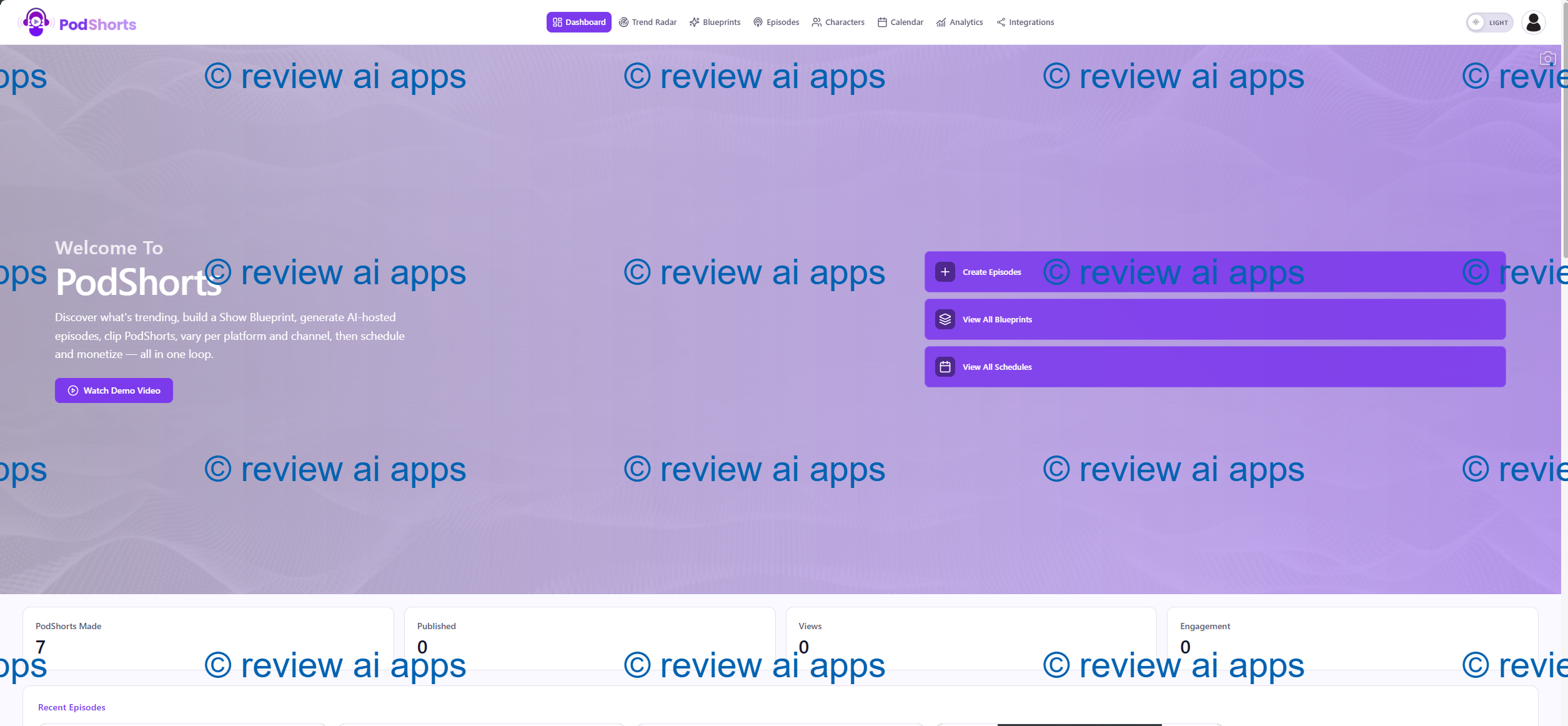
This is the member's area once you login.
1. Trend Radar
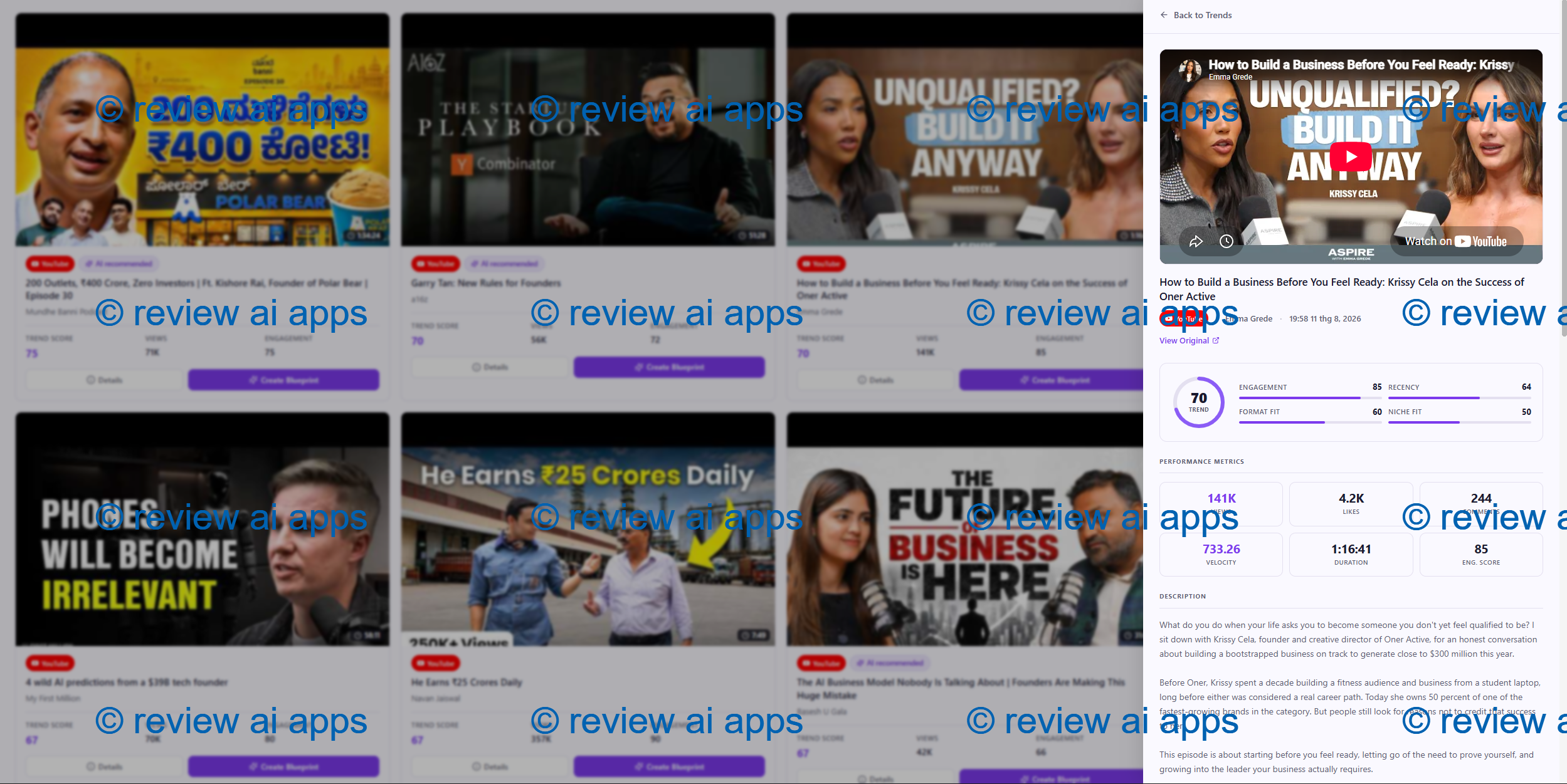
To start, you can explore the trendy content on multiple sources (including Youtube)
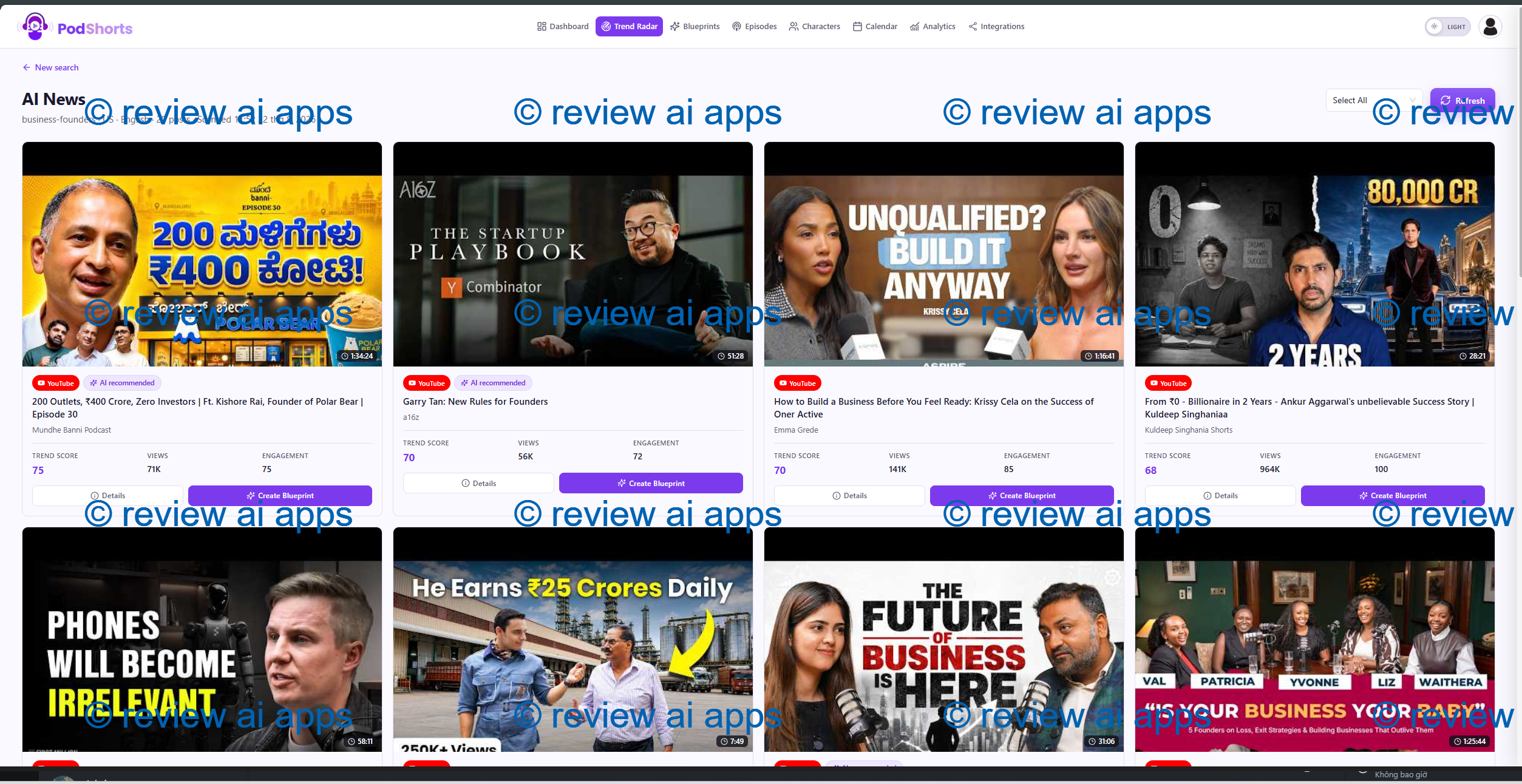
At here, choose a video you like, and you can start to repurpose into your new podcast version.
2. Create Episodes
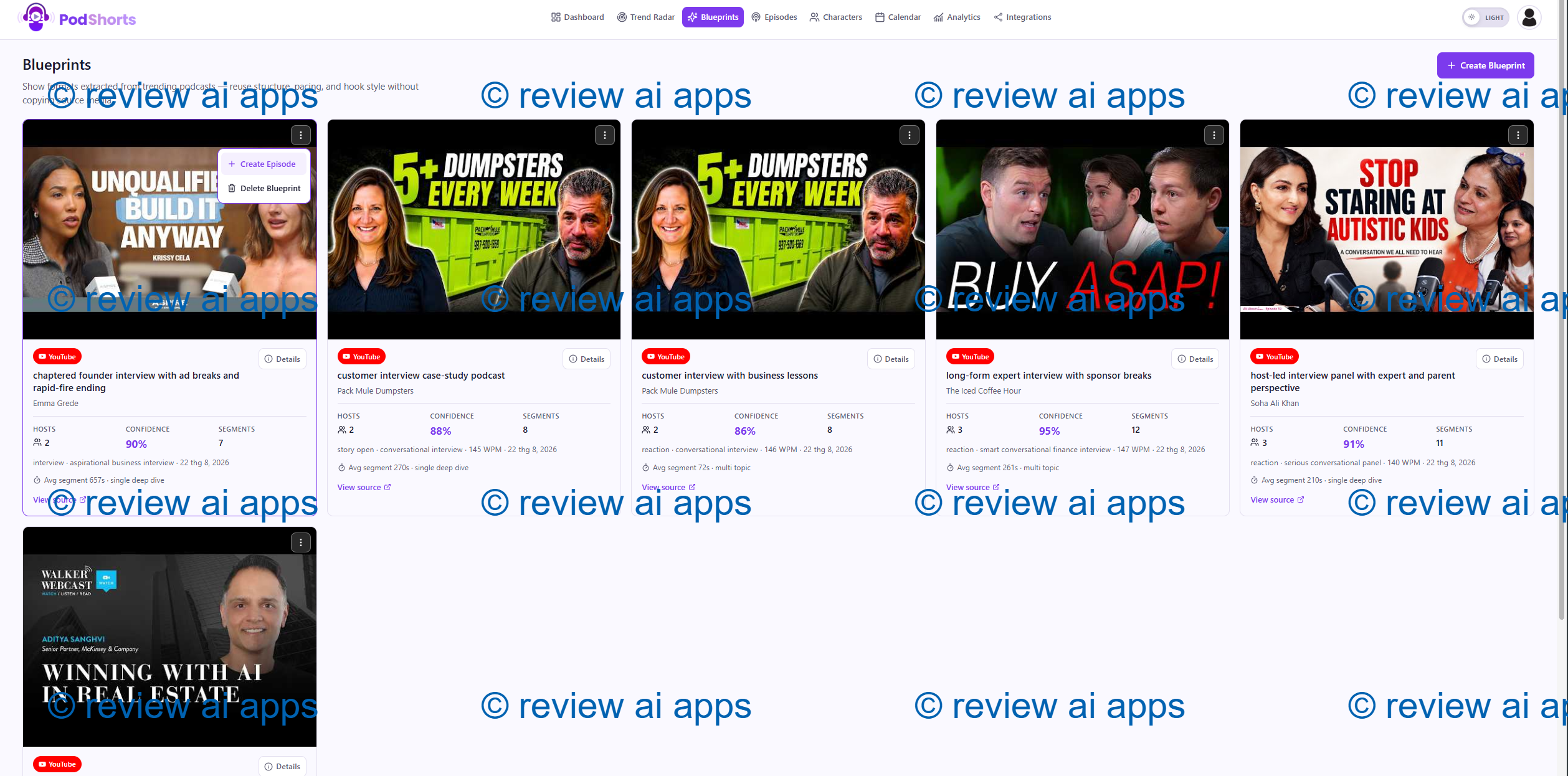
To start, choose video and click "Create Episode"
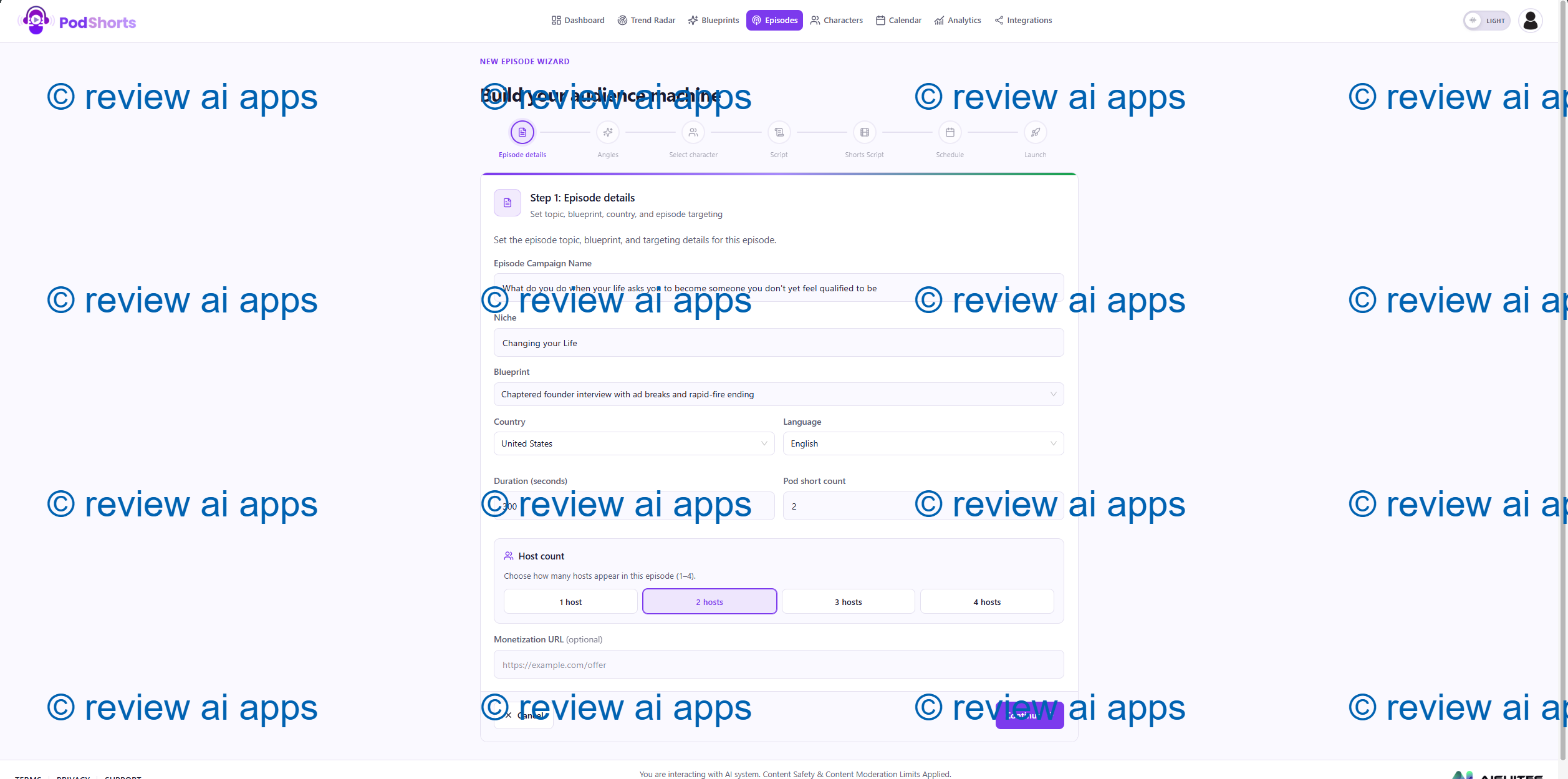
Maximum duration will be 300 seconds. At here, choose the languages, determine the amount of host to appear on podcast video.
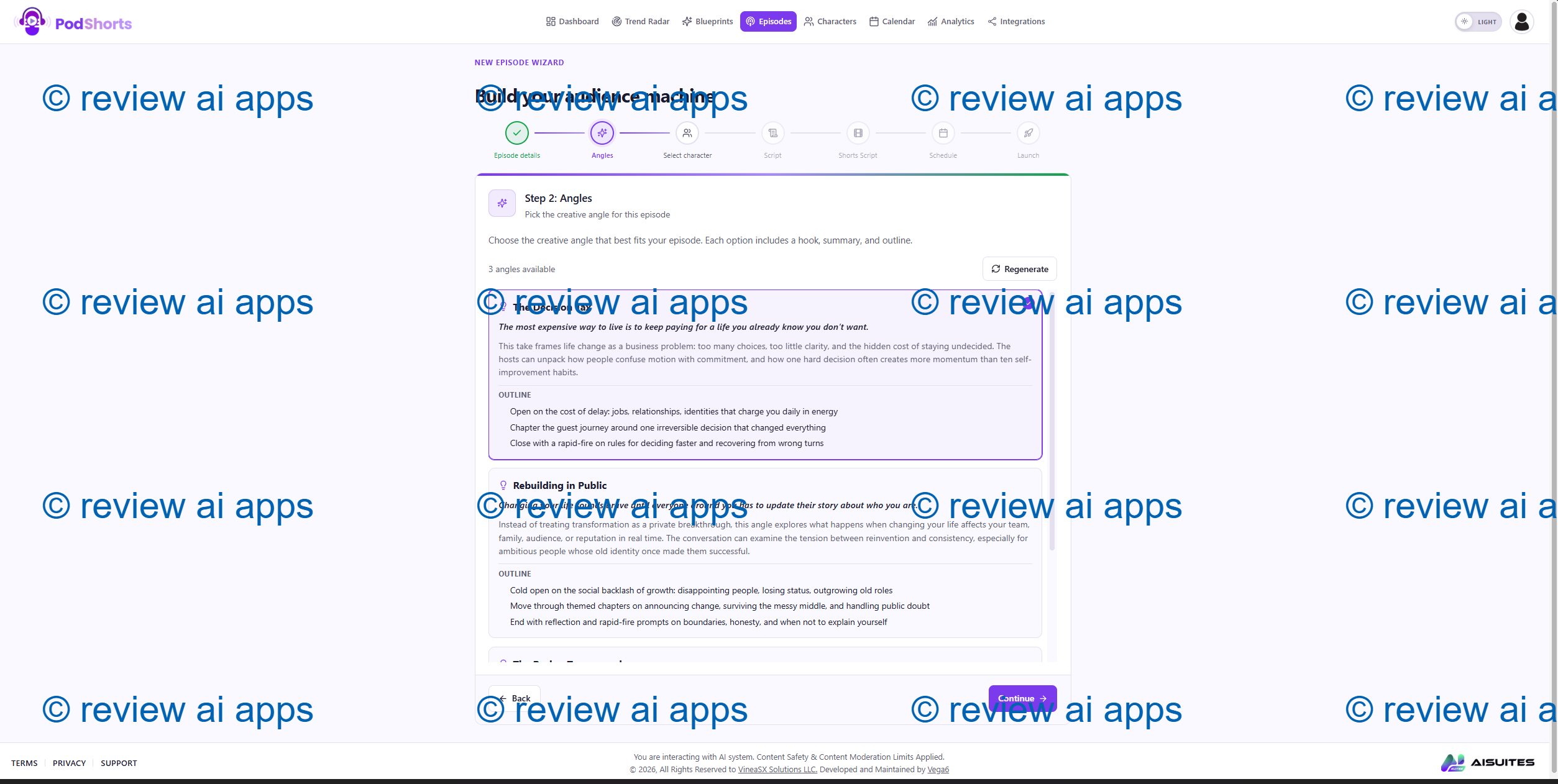
Based on the blueprint, it can generate the idea. Choose any of these three ideas.
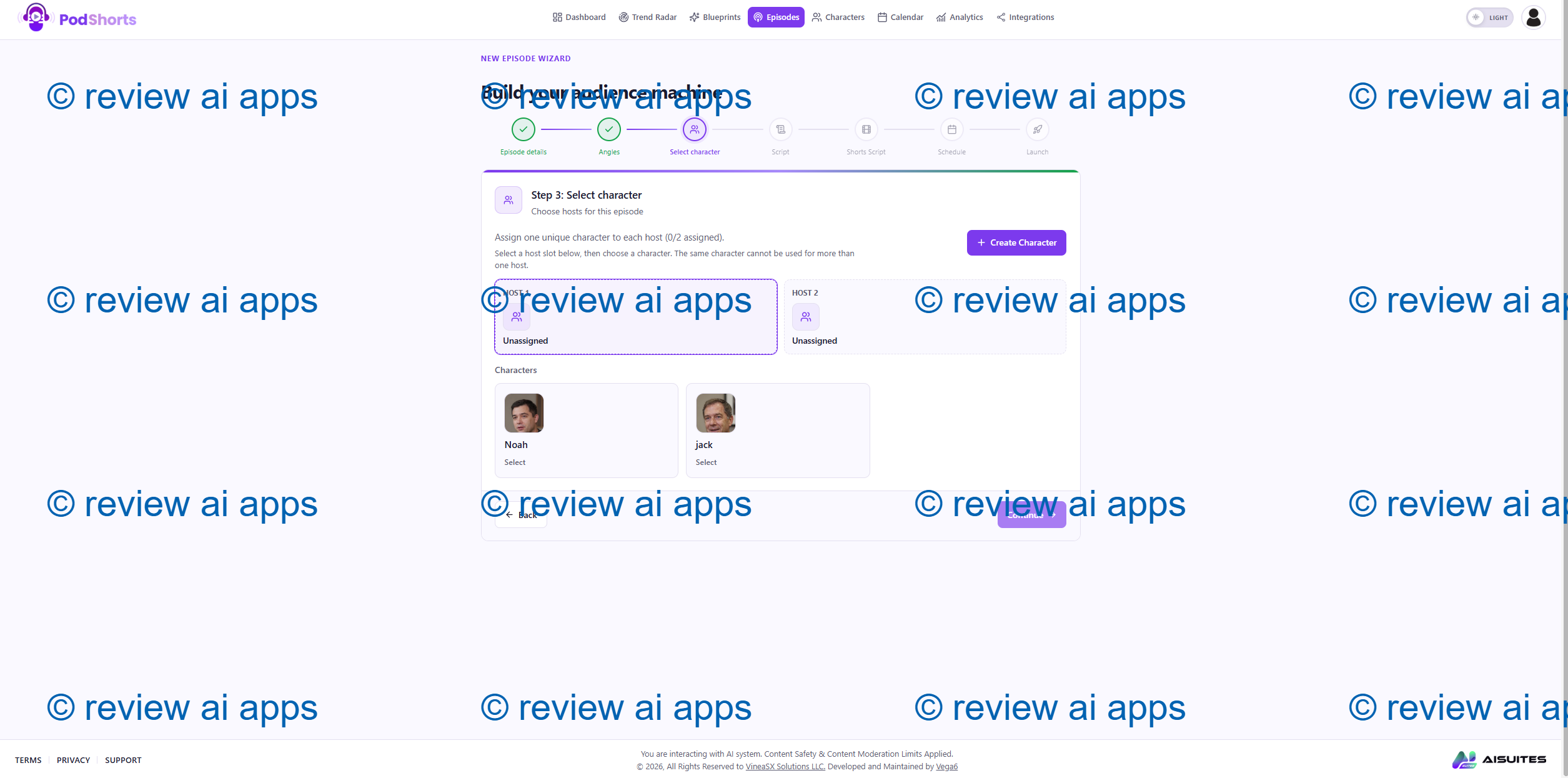
Then, select your own character. On actual video, character is just image, not about UGC video, not text-to-speech with lip-sync, so, just upload any image of your character.
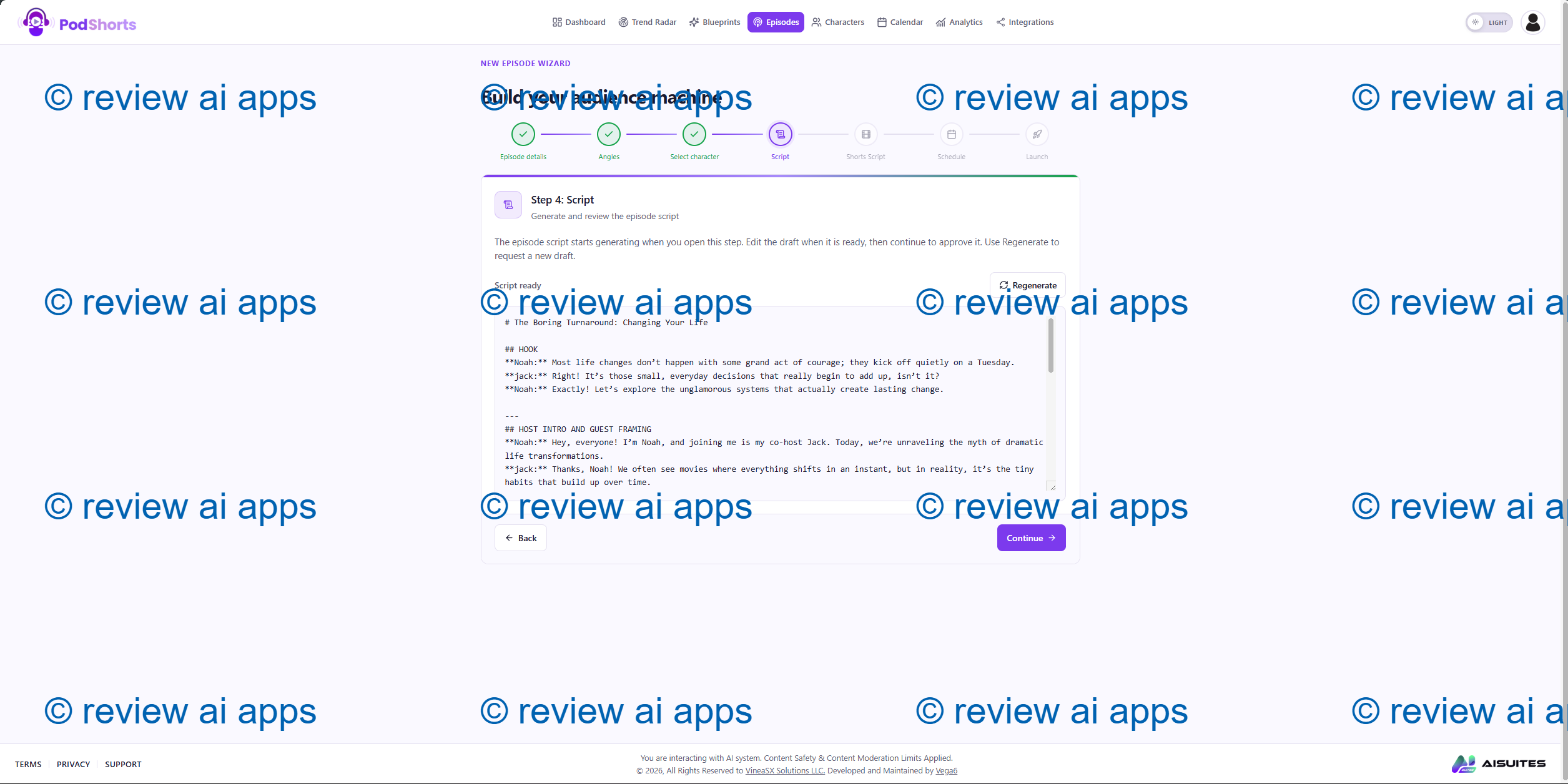
Then, it can generate script that each character will speak out.
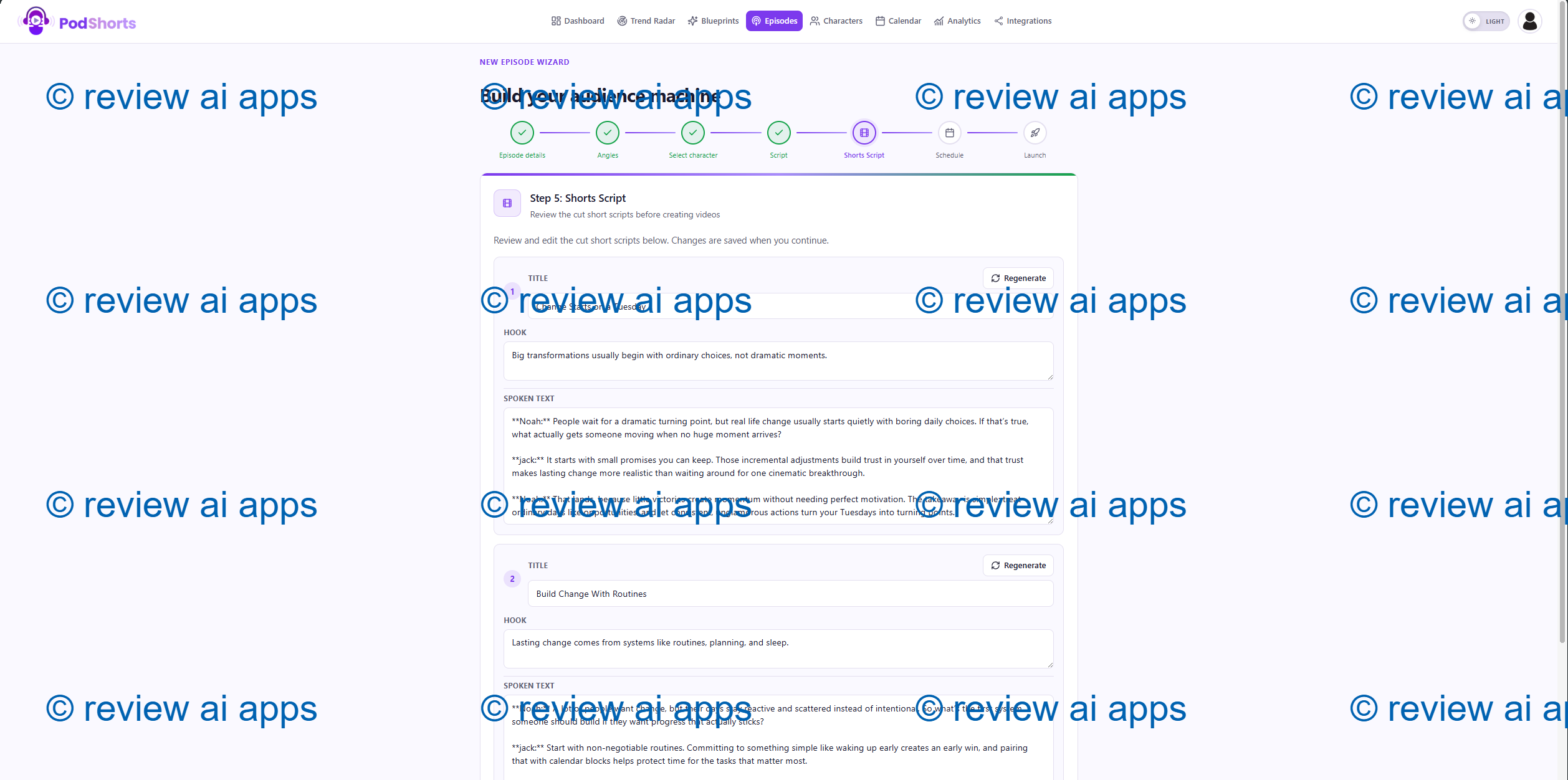
Each time, you will generate 2 variations video, so just proceed here.
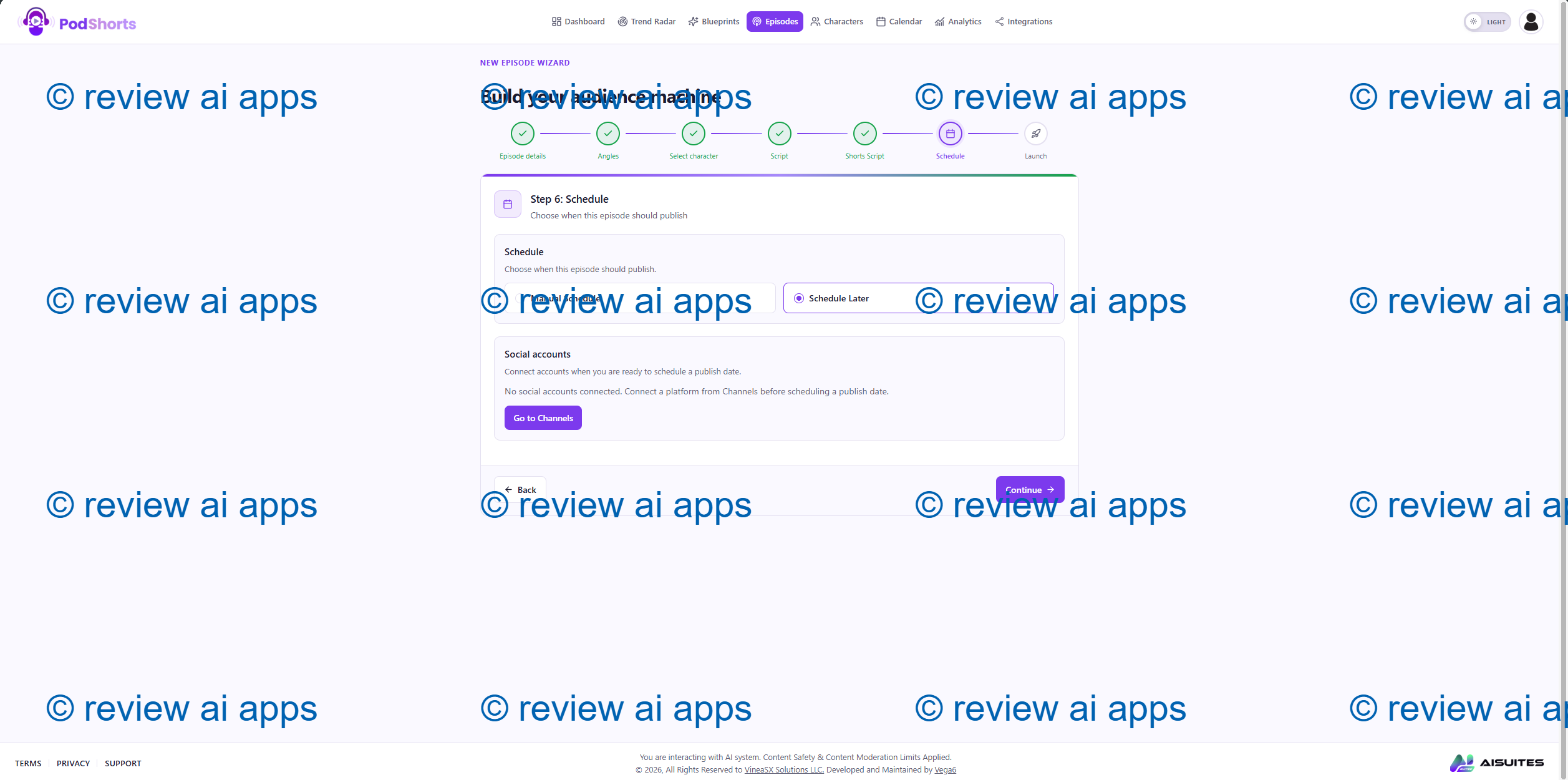
If you have integrate social networks, you can schedule for auto publishing directly. Otherwise, you can manually upload later.
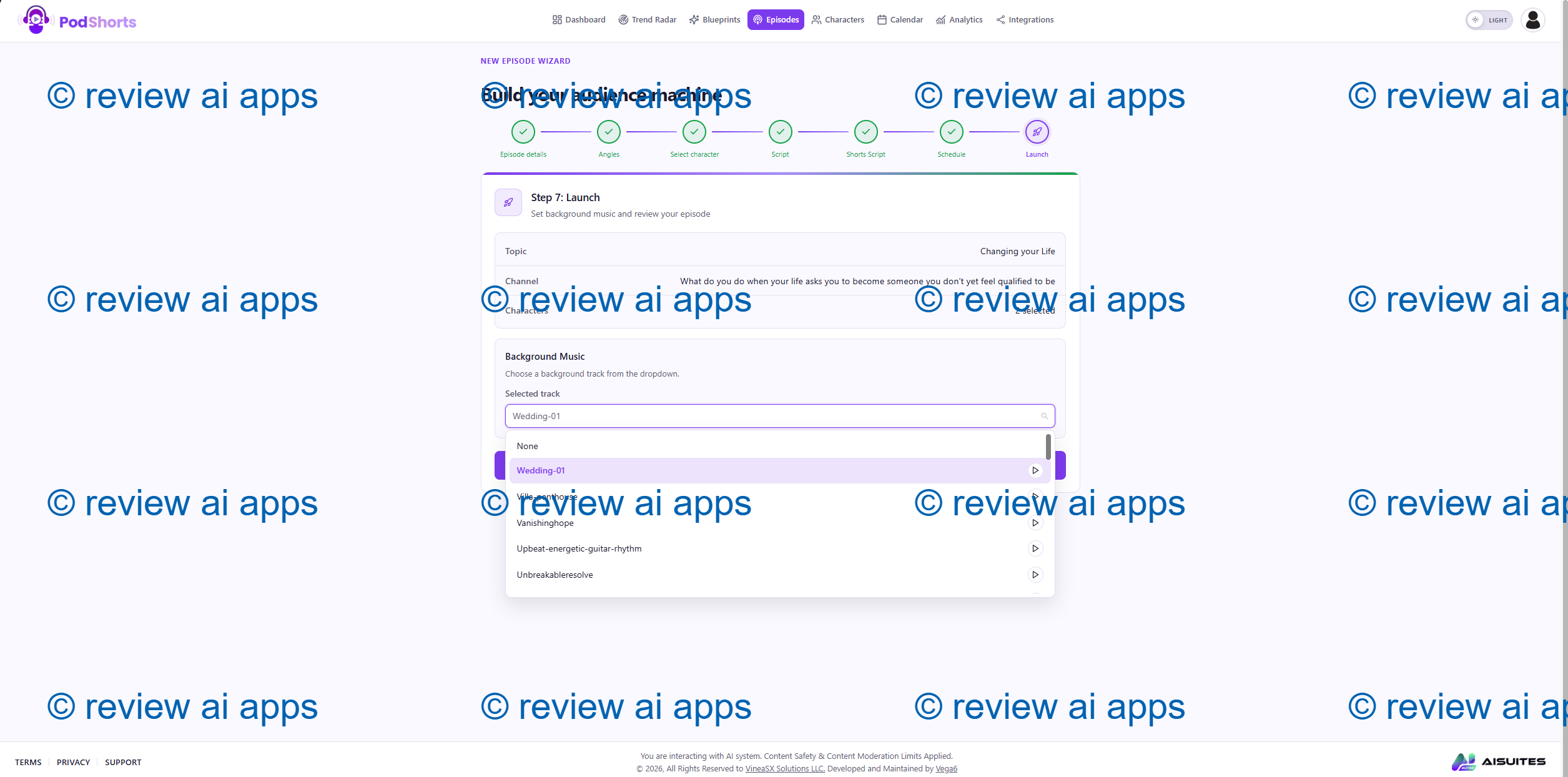
Last step is to choose background music.
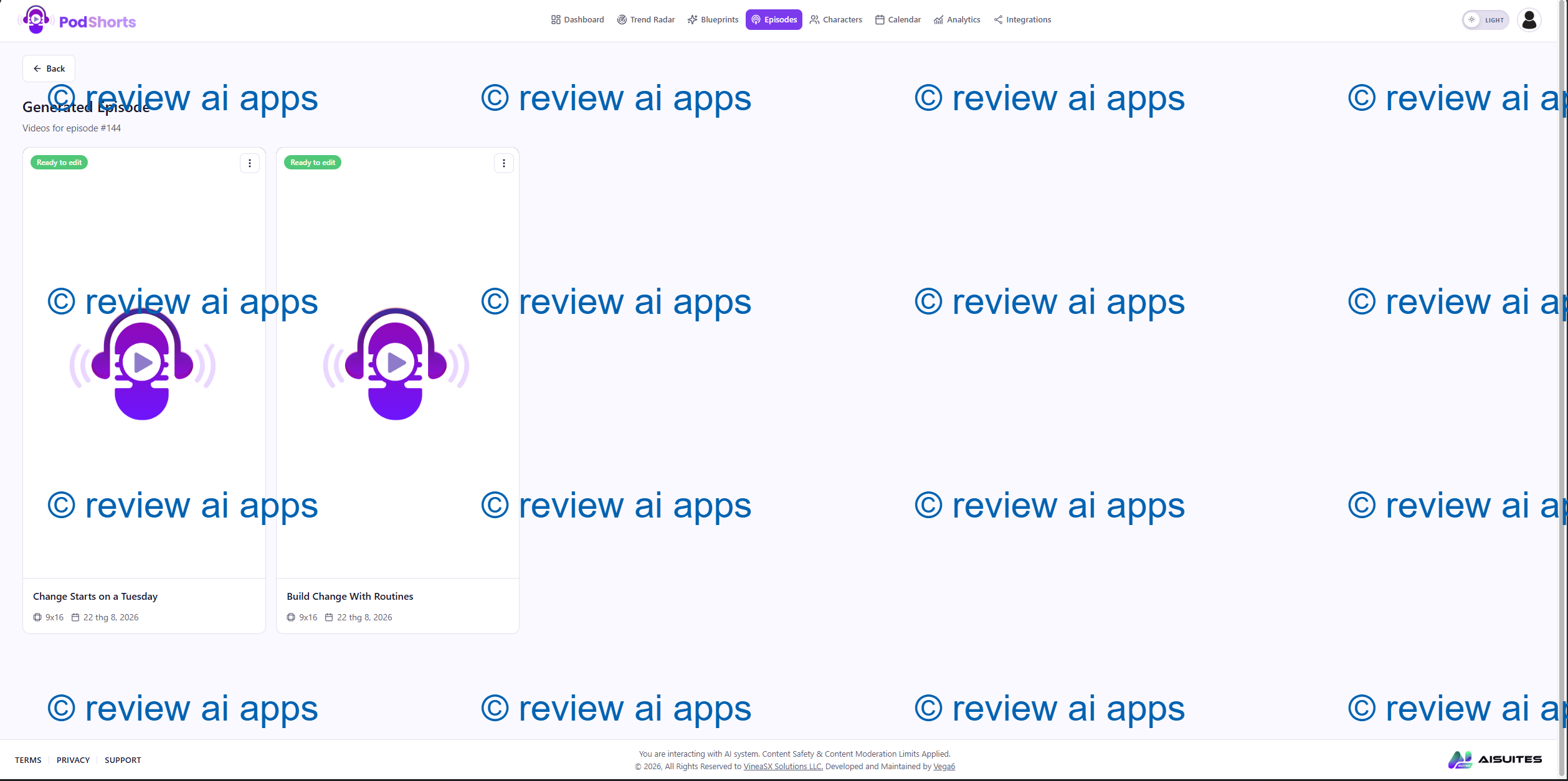
And at here, you have pre-made video scenes awaiting for customization.
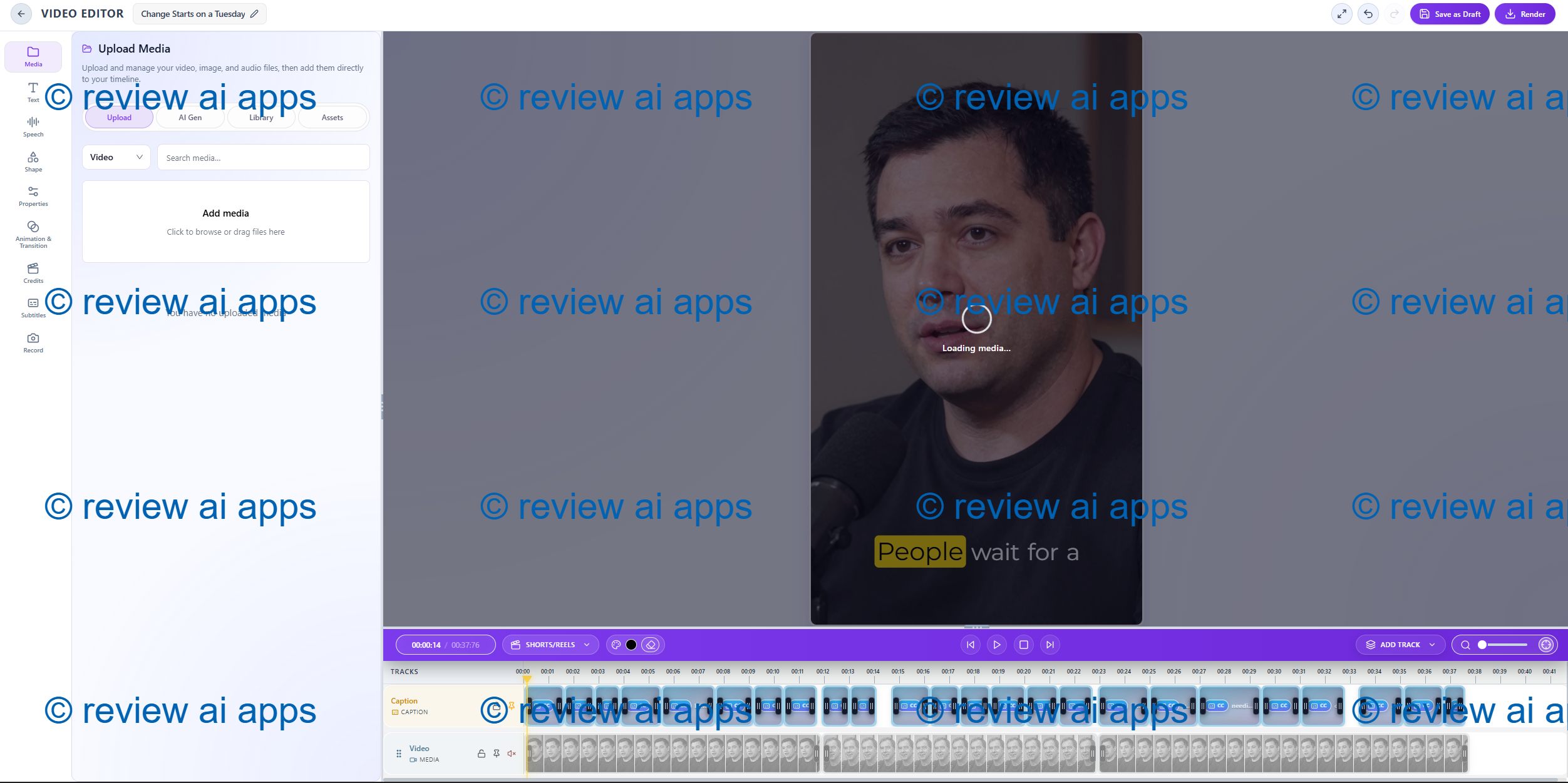
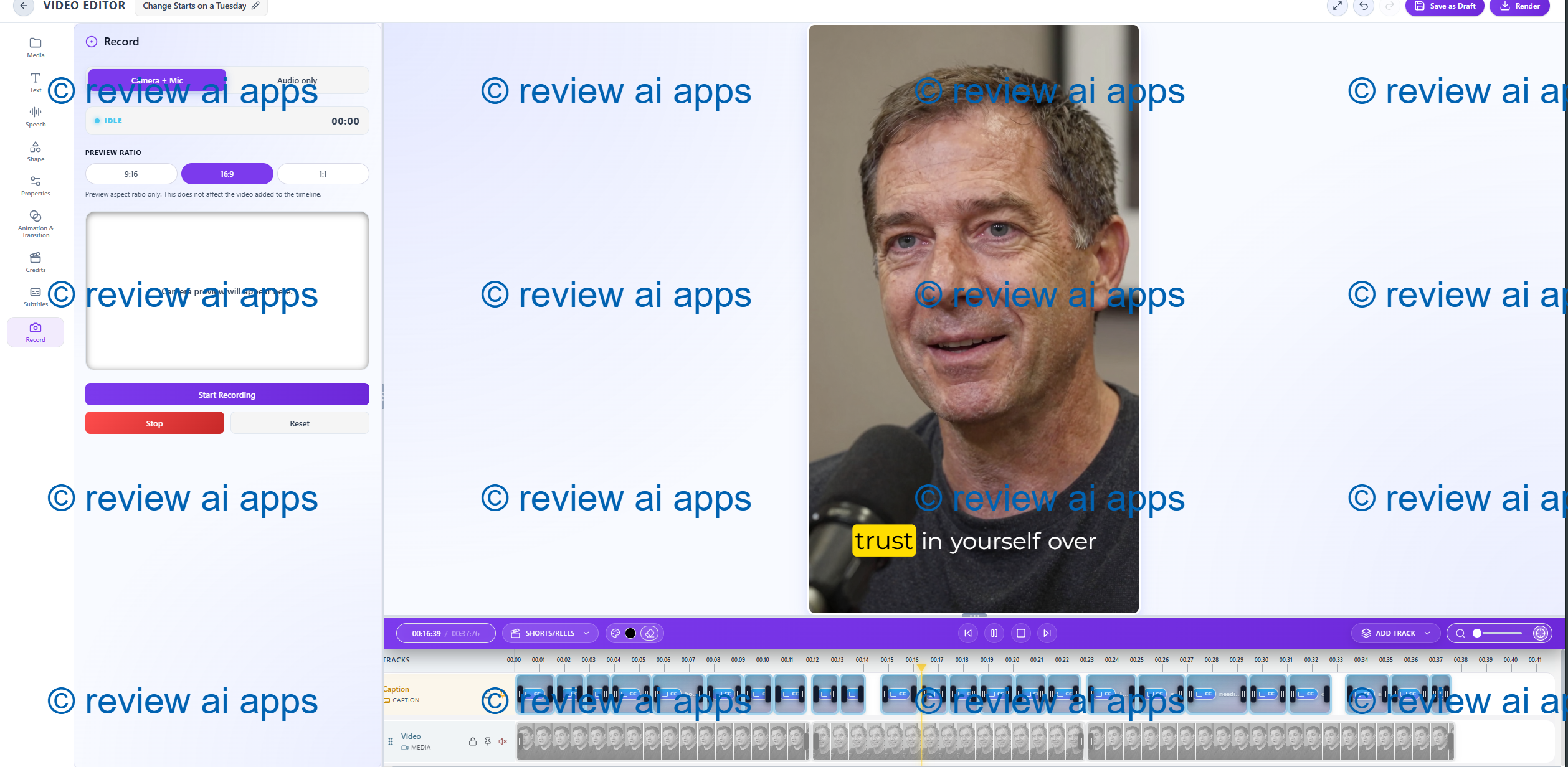
On the video editor, you can see image character of the podcast, and the preview subtitle style. Just preview them before you render.
What's Actually Included In The $37 Front-End
This is the part most reviews skip, and it's more important than the feature list.
The front-end license gives you all seven agents but with stringent conditions: one channel, 15 episodes per month, 15 clips per episode maximum, and publishing to three platforms.
Those limits are not random. The caps are the cost control, with every episode costing the vendor money in AI generation fees. This is because there are a number of things that are in the sales material that are not possible on the front-end plan. Agency upgrade needed to sell shows to local business needs. You need scale for multiple channels. To post to more than three platforms or to distribute to Spotify and Apple Podcasts, you need Amplify.
The front-end is a single channel test stand. You just need to find out if the quality of the output fits your niche, you don't need to do any of the business models the marketing talks about.
Realistic Assessment of the Five Income Paths
The product has five ways to make money and they are not equally realistic on the plan most people will buy.
The most plausible is affiliate link pages where each channel gets a monetized page with niche matched offers pre loaded and ready to go from day one. At the entry level, product tie-in episodes where the AI builds an episode around a specific offer are also possible.
Local agency retainers are quoted at $500 to $2,000 per month per client. They need the Agency upgrade plus sales skills the software doesn't offer. Channel flipping, quoted at $2,000 to $10,000, needs Scale and channels clean enough to sell. Sponsorships and creator earnings are the most distant, requiring the kind of established channel that mass-produced AI content struggles to build.
Pricing and the whole funnel
The front-end is called PodShorts Premium and is $37 one-time fee.
The FastPass Bundle is upgrade 1 and is $230 per year and includes the remaining upgrades with priority processing and onboarding.
Upgrade 2 is PodShorts Scale at 67 dollars, with a reduced 47 dollar version: ten channels, higher generation caps, bulk episode creation and higher-quality voice and video models.
Upgrade 3: PodShorts Agency, 197 dollars (Reduced version at 97 dollars) White-label client management, team access, client reporting and outreach templates.
Upgrade 4 is PodCoach AI at 97 dollars per year with a cut down version at 67 dollars. It gives you an AI growth coach trained on your dashboard data.
Upgrade 5, PodShorts Amplify, is 67 dollars and there's a reduced version for 47 dollars. Publishing goes from three platforms to fifteen, with added distribution to Spotify and Apple Podcasts, as well as blog posts generated from transcripts.
The Bundle Deal is $317 per year. Another offer, The DFY Show Network, is $197 and only offered to Bundle or FastPass buyers. The source material is inconsistent in describing it, sometimes referring to pre-built show templates that you hook up to your own accounts, and at other times referring to custom network building by the vendor's team. Please read this before purchase.
Two things are worth noting. The FastPass, the Bundle and PodCoach AI are not one-off payments but yearly charges so it's worth reading the checkout wording carefully. And better voice and video models are behind Upgrade 2, so the vendor's own pricing tells you that the $37 tier doesn't get the best models available.
Three Ways To Purchase
Customers have 3 different ways to move thru this funnel and the difference between the 3 is worth several hundred dollars.
Option 1: Buy The Front-End And Add Upgrades As Needed
You buy PodShorts Premium for $37, and then you see each upgrade in turn and accept or decline each one individually. Rejecting will not affect what you have already bought.
Say no to everything and you will pay 37 dollars for a working single channel product. The total for the first year is 465 dollars (97 dollars recurring yearly) if you take all upgrades at full price.
This path gives you the most control and is the right choice if you want to test things out before going further. This path does not show the DFY Show Network.
Option 2: Purchase The Bundle Deal
The Bundle Deal is $317 per year and is sold as one transaction that skips the front end offer and individual upgrade pages. Then, there is The DFY Show Network for 197 dollars, but only for Bundle or FastPass buyers. So, the max on this path is 514 dollars.
Expect a coupon on the Bundle that brings the price to approximately the front-end plus FastPass price and know what that is. The 317 dollar list price is the anchor that makes the coupon feel like savings. With the coupon applied the Bundle is not cheaper than the alternative route, it is equal to it.
Option 3: Purchase The Front End, Then Utilize The FastPass
You buy PodShorts Premium for 37 dollars, and then when the first upgrade is available, you take the FastPass Bundle for 230 dollars a year.
Then grab the FastPass which skips all the remaining upgrade pages because it already has them in there and unlocks the DFY Show Network. And with that offer, the first year is 267 dollars or 464 dollars. If you refuse or cancel the FastPass you go back to Option 1 and see each upgrade one at a time from there.
The Difference That Shows Up Only in Year Two
Don't just look at Option 2 and Option 3 side by side, because you can make the first-year prices the same, but you can't make the long-run costs the same.
On the FastPass route you pay 37 dollars once and then 230 dollars every year thereafter. The whole amount on Bundle route is per annum. But if the coupon only applies to the first purchase, as launch coupons generally do, then the second year is 317 dollars on the Bundle route vs 230 on the FastPass route.
That's a $87 difference a year for what appears to be the same package, and it's invisible until twelve months after the decision. Look at what is included in both packages and the renewal terms before you decide.
The Guaranty, And Why It's Relevant Here
Most products from this vendor are backed by a 14-day money-back guaranty and renewals are not refundable. PodShorts terms to be confirmed on checkout page at launch.
14 days is a tight window for any software, but here it is especially tight because it does not live up to the product's own promises. Building a channel, or traction to flip it, or getting a local client are in months, not two weeks for a short-form algorithm to hand down a verdict. So the refund window closes before the buyer can know if the product will work for their situation. The difference is larger on the annual routes: 14 days of protection for a 365-day commitment, and on the Bundle route the full amount is paid before a single episode has been generated.
Where Marketing Overstates The Case
The stats they quote from the sales material about podcast advertising are correct. IAB and PwC said the U.S. had $2.862 billion in podcast advertising revenue in 2025, up about 18 percent. Survey research does show that a lot of podcast listeners buy products they hear about on shows.
The problem is that those numbers are measuring something that PodShorts doesn't make. "Podcast advertising converts because of the relationship between a listener and a particular human host built over many hours. The listener buys because someone they trust said so and that trust is the whole mechanism behind all those statistics.
PodShorts is a show about a conversation between AI personas no one listens to. No host, no relationship, no accumulated trust. So the numbers don't carry over. The industry revenue number is even further out, since that money goes to established shows and networks, not to a new account posting clips with an affiliate link in the bio.
Nothing here is factually wrong. It's leveraging one company's credibility to sell another and it's the biggest hurdle to get over before you buy.
Other claims are individually weaker. The product is advertized as the first of its kind on this marketplace, but there have been AI podcast generation products sold on it before. 37 dollar vs 3,000 dollar per month production stack comparison is choosing the most expensive possible alternative when the real one is a free clipping tool, and a chatbot. The statistic that 74 percent of short form views come from non-subscribers has no named source, but speaks to the core objection that a new user has no audience. And the virality score on every clip is a heuristic that's marketed as a measurement, because no tool can actually predict what will spread.
The compliance challenge
This is the most serious problem in the product, and it is a problem arising from the product's own feature list and not from external criticism.
PodShorts is promoted as compliance-first, with automatic AI labeling, licensed music only and originality checking. It also ships the Variation Engine, which is said to make each post platform-unique so as to avoid duplicate-content suppression. In layman's terms, that's a detection-avoidance feature. You cannot be compliance-first and sell an evasion module at the same time.
More to the point, the evasion is on the wrong issue. In July 2025, YouTube changed its rule on repetitious content to inauthentic content, explicitly mentioning repetitive and mass-produced videos, and further clarified it in July 2026. The test is can content be replicable at scale, following a template with little variation. This is across a whole channel, not video by video. Enforcement has been real — including a wave of early 2026 terminations that hit accounts with billions of accumulated views.
Changing captions and hooks between platforms doesn't do anything about that test. There is a channel of AI-hosted episodes on AI-selected topics, auto-clipped and auto-posted, that is close to what the policy targets. What the policy asks is whether a human contributed anything. Because it's a measurement of the channel as a whole, one weak channel affects the whole account, and matters to anyone running ten of them with Scale.
Credit and disclosure alone does not cost a creator monetization or reach, but the labeling by automatic AI is deserving of credit. But the product requires disclosure and mass production, and it is the mass production that triggers the policy. The sales material makes compliance and scale seem compatible. On current platform rules they pull against each other .
That's the tough form of platform risk. Rules aren't going to change someday. They changed . Already . Twice . Enforcement is already happening .
A Note On Sustainability
A one-time $37 payment gets you AI generation from a third-party model provider who loses money on every request forever. There's no ongoing revenue on the front end to pay for it.
That arithmetic tends to get resolved in one of three ways: caps are tightened quietly, models are swapped out for cheaper ones, or development slows and the product goes quiet. The funnel says the vendor knows this, because the real money is annual and multiple upgrades sell priority processing, which is what you sell when compute is the bottleneck.
This isn't a prediction that PodShorts will go away. And that's why the one-off payment can be considered as paying for access for the lifetime of the product.
About The Seller
PodShorts is created by Abhi Dwivedi via VineaSX Solutions LLC in the UAE and distributed via JVZoo as retailer of record. The vendor has listed more than 36 products over about 20 years, more than 20 million dollars in sales, and has been repeatedly recognized as a top platform vendor. Previous products include ContentClaw, CourseReelAI, MovieReel, AffiliateReelAI and AICallings and the launch support team are kept up for 24 hours.
That's a proven track record and it reduces the risk of the product never being delivered. The other side is the cadence of releases. This vendor ships a lot and a closely related product, ContentClaw, was released just weeks ago. The practical reason not to buy assuming years of updates is high cadence tends to mean attention moves on to the next launch.
Testimonials & Income Claims
Four beta testers quoted with specific results, none verifiable pre-launch. Two of these are worth reading closely.
Someone reported getting 2 local dental clients at $750 a month within 3 weeks. That is agency work. The 37 dollar license does not allow for this, you need to buy the 197 dollar Agency upgrade. The most impressive income figure describes a result that the advertized product can not produce.
Another says he made 31 dollars on day six with an auto-rotated offer. The figure is honest and is presented as proof the system works unsupervised. But 31 dollars in six days is a small amount and may or may not continue. It is not the number but the weight given to it that is the problem.
What is really good
There's real value to this and a fair review should say so.
The workflow aggregation is valid. One interface that provides topic research, scripting, voicing, clipping, captioning, scheduling and a monetized link page is a meaningful saving over assembling five separate tools, and it removes a number of the steps that stop people publishing consistently.
Automatic AI content labeling is built-in rather than left to the user and that is better than several of the competing products. The entry price is very low: 37 dollars is not much to find out if the output quality is good enough for a niche. And the product's premise makes sense, because conversation clips perform well, and the old way of making them is slow.
Who to Buy, Who Not to Buy
PodShorts is for someone who knows their niche, has an offer they want to promote, and wants to test short-form at volume, cheaply. That person should see the output as a raw material to review, edit and add their perspective to; not finished content to publish as is. Used in this way the tool saves real time and the compliance risk is lower.
It's not as well suited to agencies as the marketing suggests, because the client-facing capability is behind a $197 upgrade and the software does none of the sales work. It fits the absolute beginner who has no audience and no offer least of all considering that is the audience marketing targets hardest. The product offers volume but no judgment and volume without human input is exactly what platforms are now penalizing.
The Sentence
PodShorts is a decent bit of automation in a sales story that over-promises on what the tool can actually do. The seven-agent workflow is real and the consolidation is valuable. The podcast advertising stats used to justify it paint a picture of a business the product does not participate in. The compliance positioning runs counter to one of the product's own features, and the relevant platform rules have been tightened twice already with visible enforcement.
At $37 for a single channel, it is a defensible experiment for someone with an existing niche and offer that uses the output as a starting point. Upgrade paths demand more caution:
Decide if you want multiple channels or client features before the timer pressure kicks in.
Consider the Bundle or FastPass routes on renewal cost, not first-year price.
Remember that the refund window closes long before the promises could be tested.
Buy it to save you time on work you've already done. Don't buy it thinking that the understanding will come from the automation.
Stuff that can't be verified pre-launch, but is worth verifying on the live pages: The itemized contents of the Bundle vs the FastPass, whether the coupon applies at renewal, the real nature of The DFY Show Network, the verified refund period and whether automated posting is done using official platform interfaces.

$317 → $267 — you save $50
🎁 VISIT MY BONUS PAGE 🎯