
iGloo App AI Review
An Honest Look At The Community Platform You Run By Typing
One moment in the demonstration of the iGloo App AI does most of the selling. Sam Bakker fires up the AI assistant he’s already paying for, types in a plain-English instruction, and a community appears on screen. The next thing is a course. Four doctrines. Weekly Drip. Published: All in one continuous shot, no cuts, no dashboard clicking.
If you’ve spent any time around software launches, you know a demo like that is designed to short circuit your judgment. It looks like magic. Magic sells.
So this review instead asks the less glowing questions. What is the software, what does the funnel really cost, and where does the marketing extend beyond the reach of the product? Some of the following is good news. Some of it is not even in the sales copy.
One note first, for it saves confusion. If you purchased a product called iGloo App a few years ago, that was a landing page and website builder. This is not that product or an upgrade to that product. Community platform iGloo App AI is a community platform. Same brand, totally different software.
🚀 GET IGloo App AI + MY EXCLUSIVE BONUSES 🎁
What is iGloo App AI?
The iGloo App AI is a hosted community platform. Remove the launch language. You have your own space with a feed where members post, comment, an area for courses where you can publish and sell training, an events calendar, member profiles with roles, direct chat and a gamified progression system that rewards people for participating.
That’s structurally in the same category as Skool, Circle, Mighty Networks and the rest. The feature list is not exotic, and the vendor does not pretend it is.
The difference is under the interface for iGloo. The platform is designed for an AI agent to operate over MCP, the open standard that enables an assistant like Claude or ChatGPT to connect to external software and take action within it. iGloo makes thirty documented tools available through that connection. If the assistant is connected, you can tell it to create a community, invite members, publish a post, schedule a recurring event, build an entire course structure, set a drip schedule, wire up your joining questions, or set up a reward ladder and it will do what you tell it by calling the relevant tools directly.
That's the real product thesis. Most community software predates the current AI wave, and had a chat box bolted on. iGloo was built so the control surface is the AI, not a feature stuck on the side. Whether that matters to you depends on if you work this way already.
the Seller
Sam Bakker is a New Zealand based software founder who has been building and launching products in this market for over a decade. Sam Bakker iGloo App AI . The launch is on JVZoo and opens 14 September 2026 at 11:00 am Eastern and the front-end price is $37 and includes a thirty day money back guaranty.
Bakker is not a one-product man. He’s building a connected stack: GoCushy for checkout and cart, iGloo for community, and then standalone products for contests, education, etc. iGloo is supposed to be in that stack, not beside it. It’s more important than it sounds.
There are two things to commend in the running of this launch. The software is live and in production, not a pre-sale with a delivery date promised. And the marketing is surprisingly subdued for this marketplace; no fake testimonials, no made-up user counts, no star ratings, no countdown timers, no income claims. The vendor lists the things the product cannot do. That is a low bar in absolute terms and a high one relative to the neighborhood and it doesn’t substitute for evaluating the software.
Inside The Platform
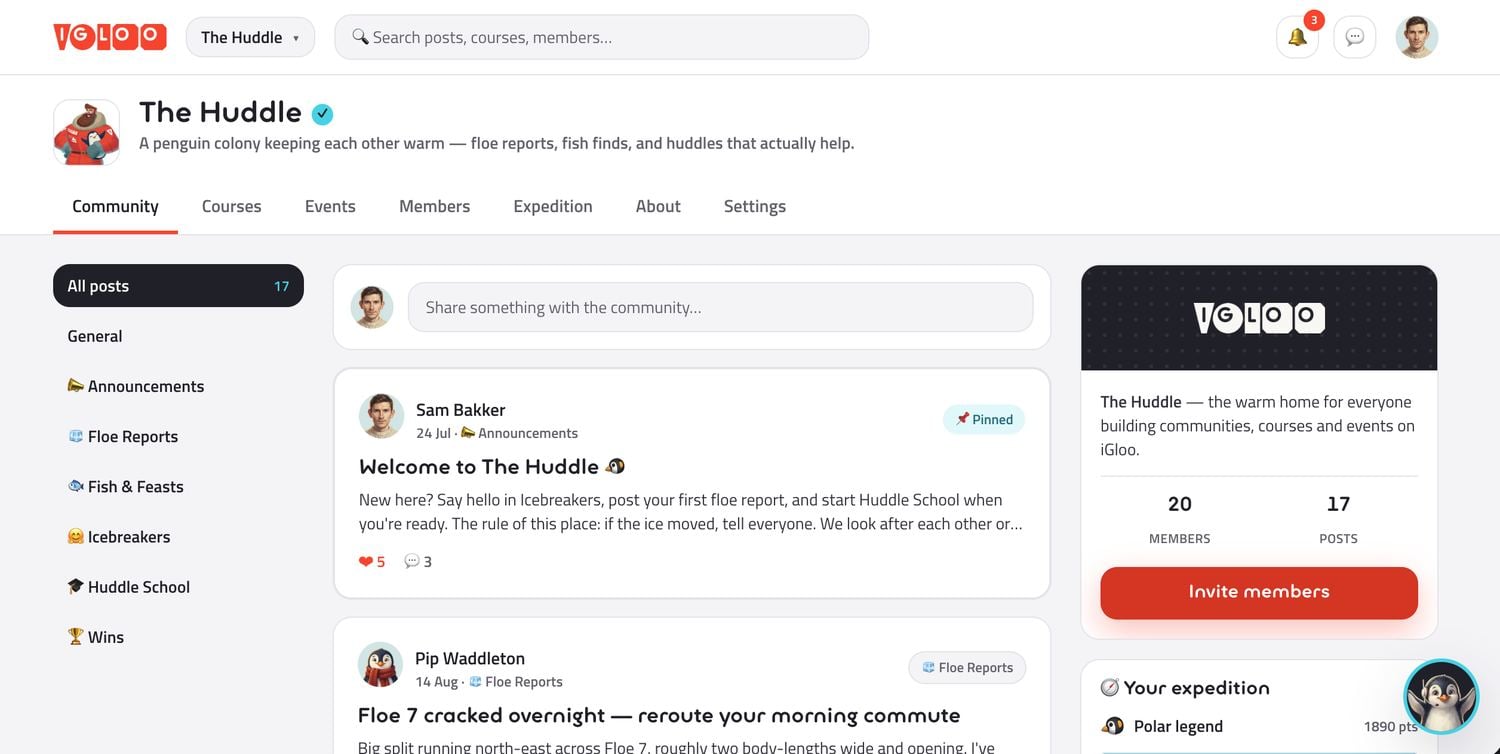
Once logged the layout is clean and instantly legible. At the top you’ll see Community, Courses, Events, Members, Expedition, About and Settings.
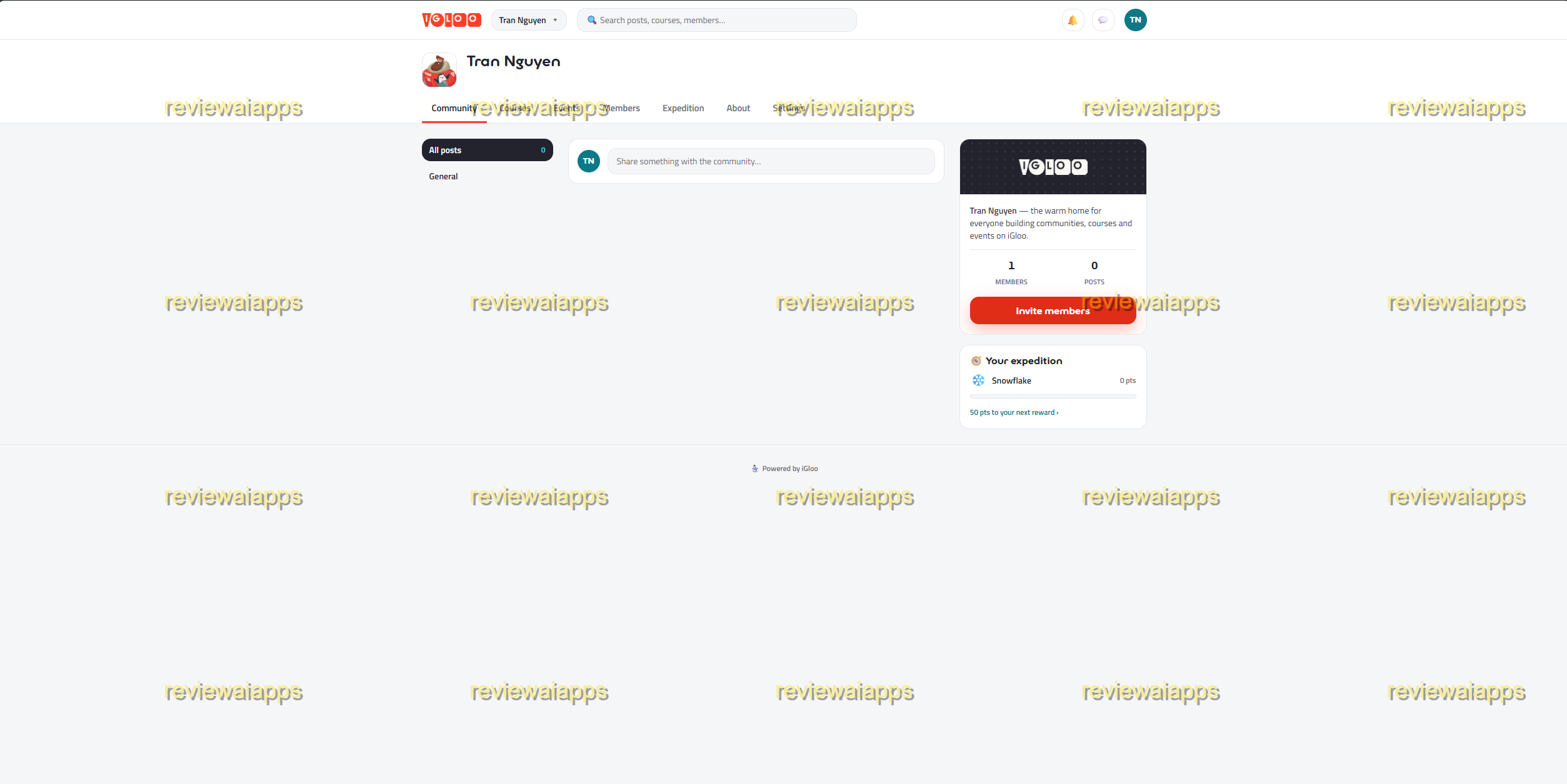
The Community tab is your feed. You can categorize posts, and a sidebar displays member and post numbers along with an invite button. Members post, Nothing surprising, and that’s the idea: it acts like people expect a community feed to act.
Expedition is the gaming layer. It’s a five-tier ladder based on points with default names that are ice-themed starting at Snowflake and a visible progress bar to show how many points a member needs to get to the next reward. You can rename the levels to suit your niche. What's cool about levels is what you can add to them. Each one can trigger a text message promise, automatic enrollment into a course, a direct chat message from you as the owner or an outbound webhook that fires into another system. When a member levels up, rewards are automatically triggered.
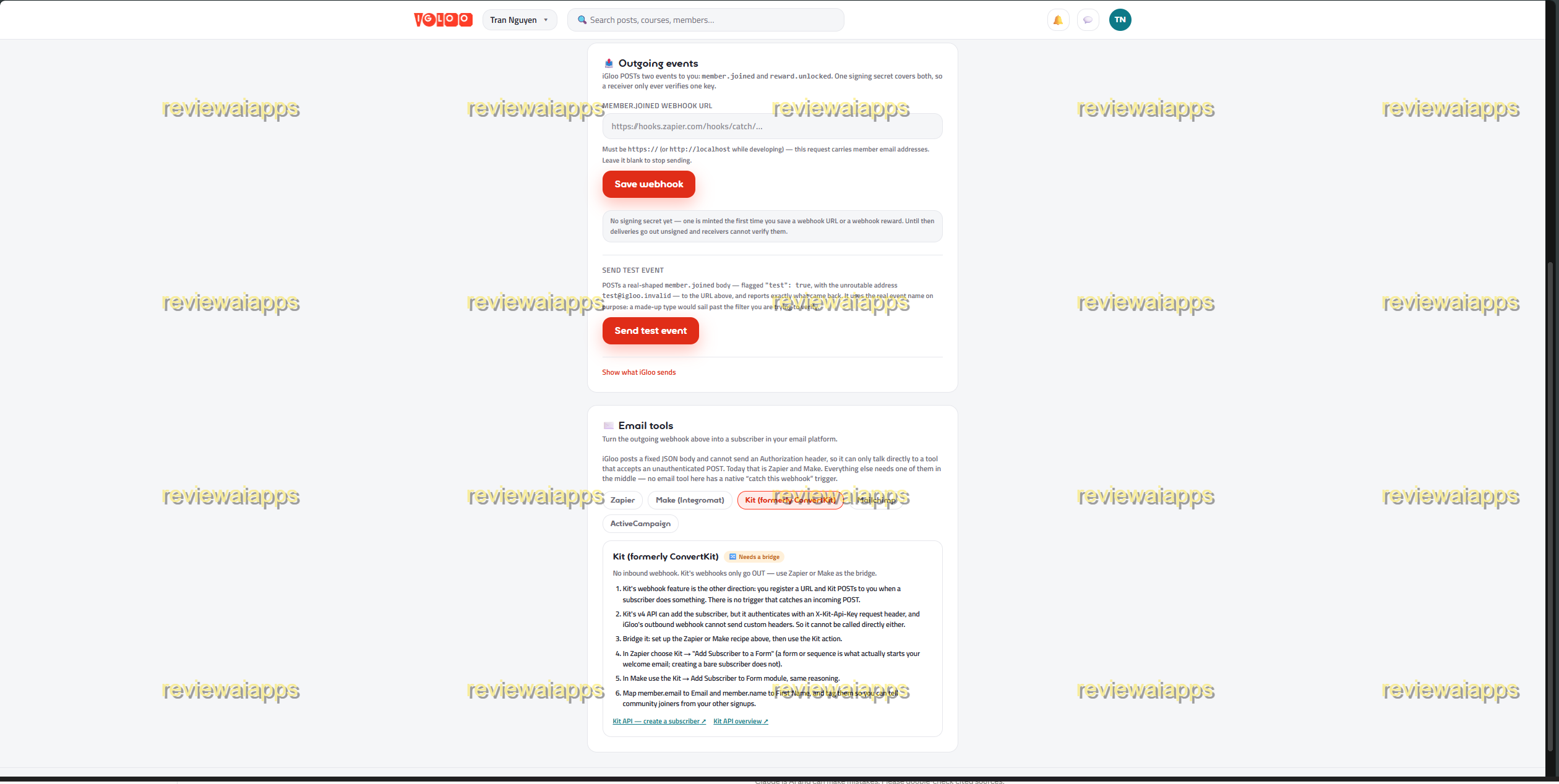
The last option is the interesting one. A webhook reward means you can push a signed request from level four into Zapier or Make and from there into anything: a coupon code, a CRM tag, a physical fulfillment.
Members deals with the administrative side of things: roles, levels, and a queue of pending joins. You can require approval before someone gets in, and read their joining answers before deciding.
Settings is where the configuration lives, divided into General, Categories, Onboarding, Branding, Rewards, Connect and AI.
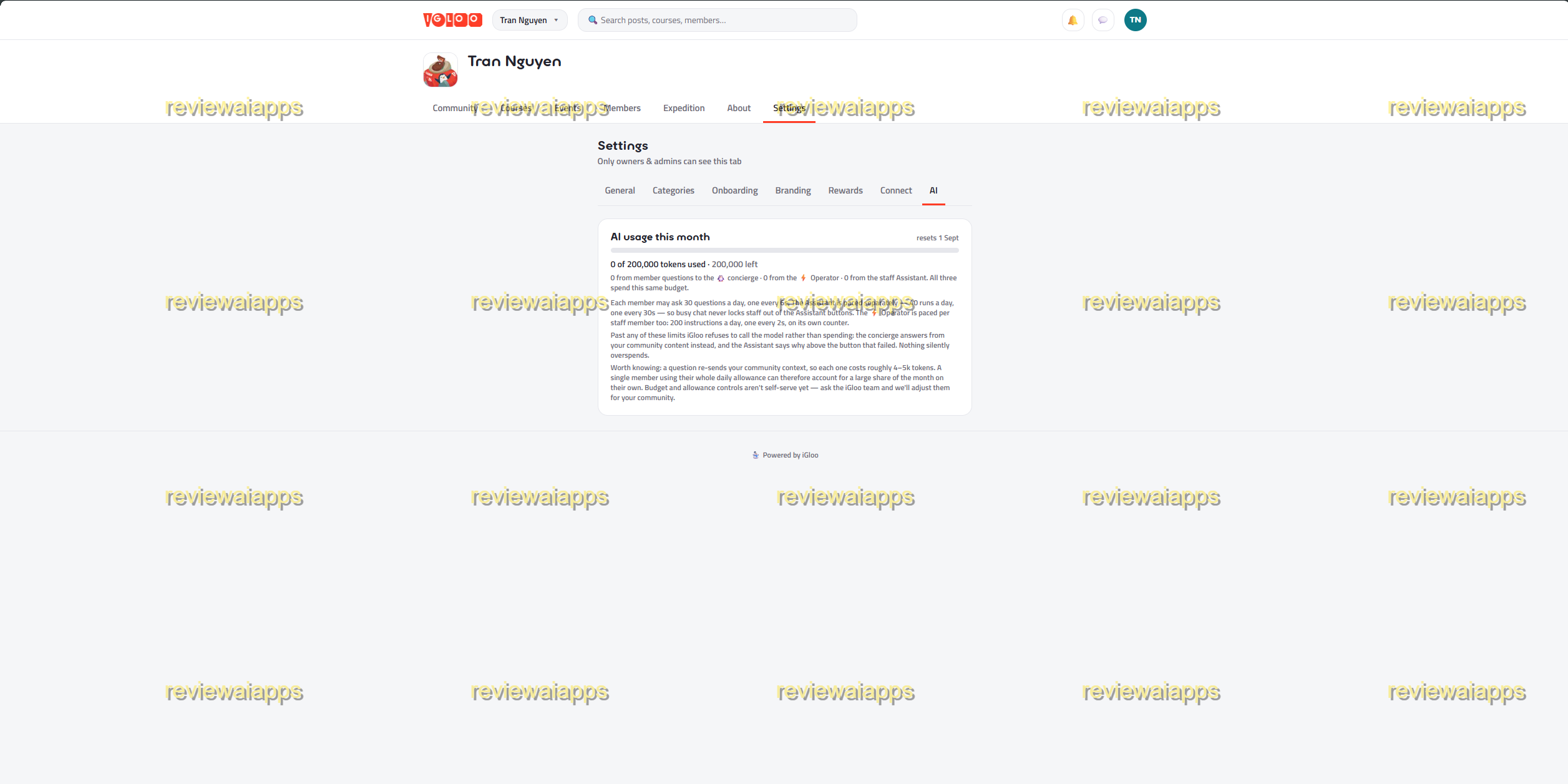
Onboarding lets you set up to five joining questions and attach a webhook that fires when a new member becomes active, passing their email, name, handle and answers.
Sell Courses and Digital Content
That is where most buyers are going to put their attention so it deserves detail.
The course structure is simple: course contains modules, modules contain lessons.
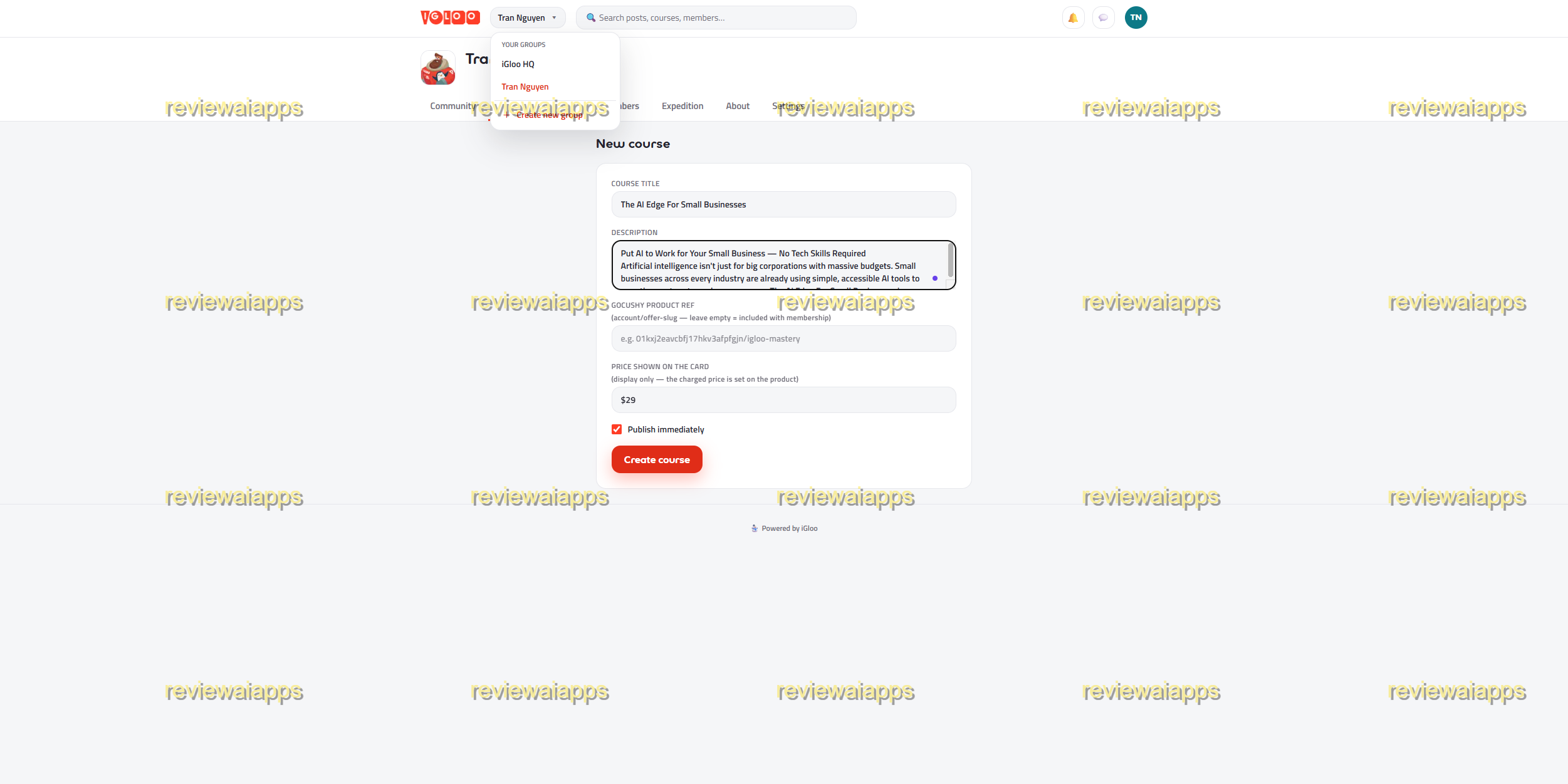
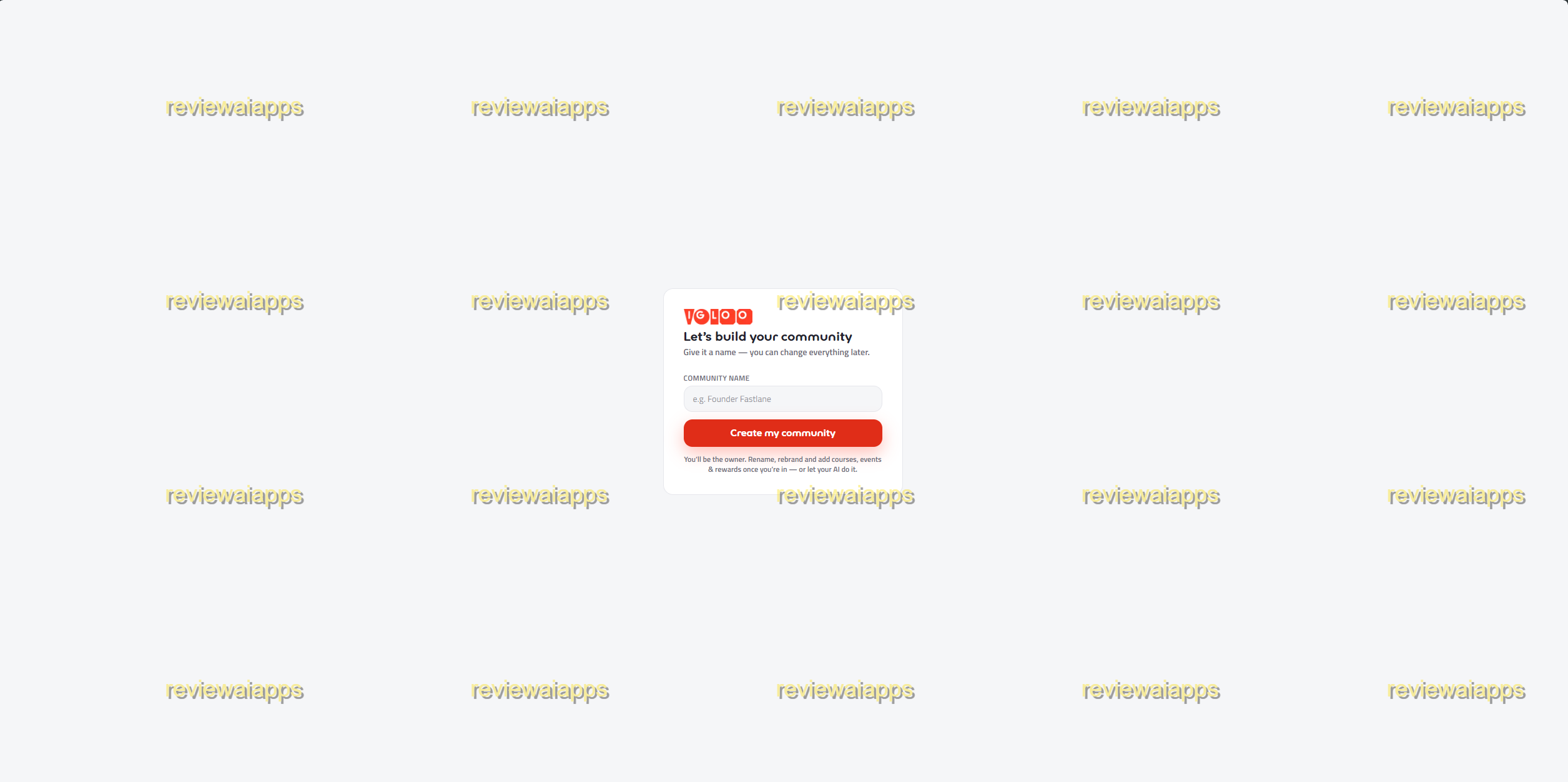
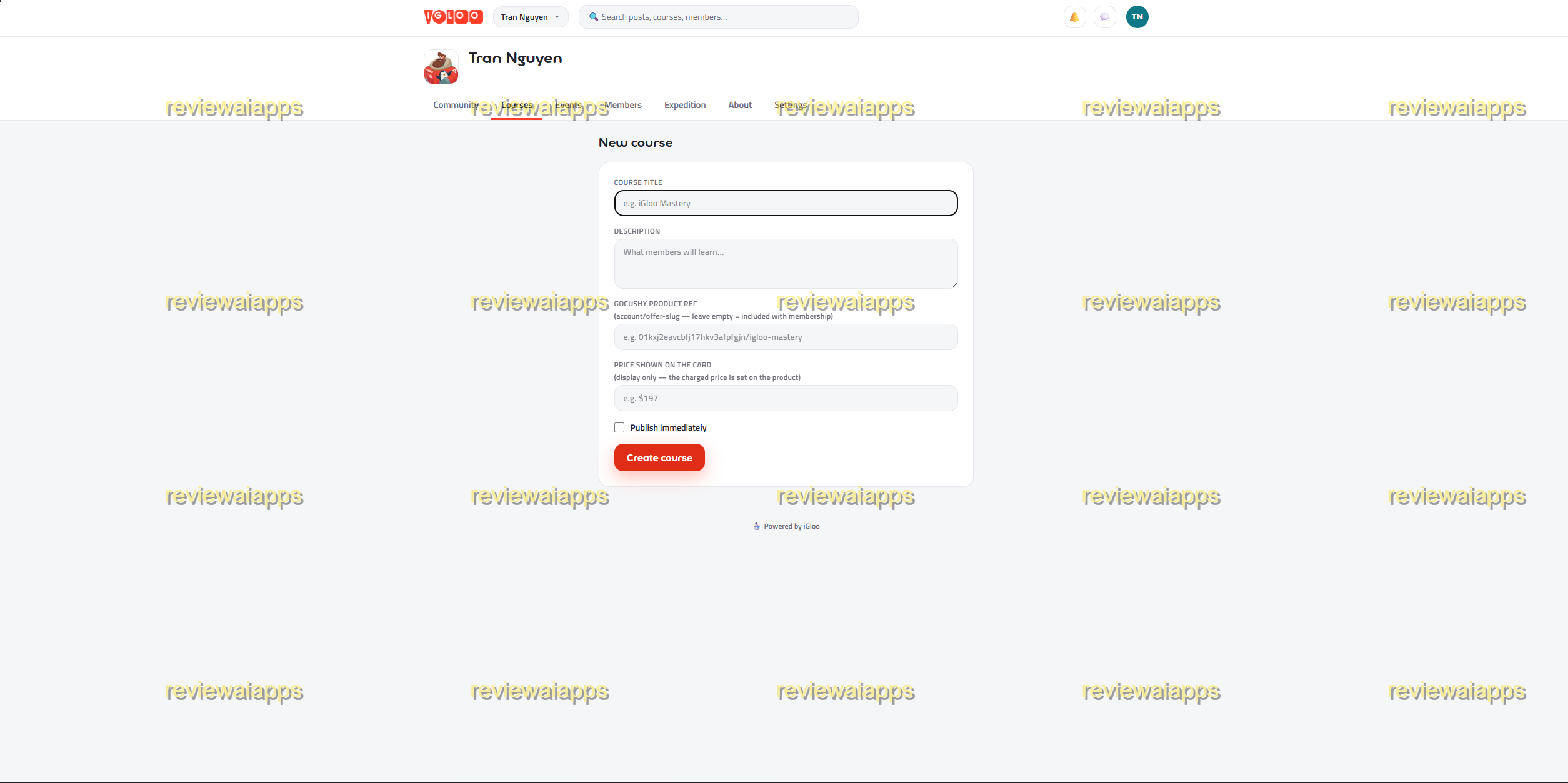
To build one, you are prompted to give a title, description, optional product reference to charge for access, display price, and publish toggle.
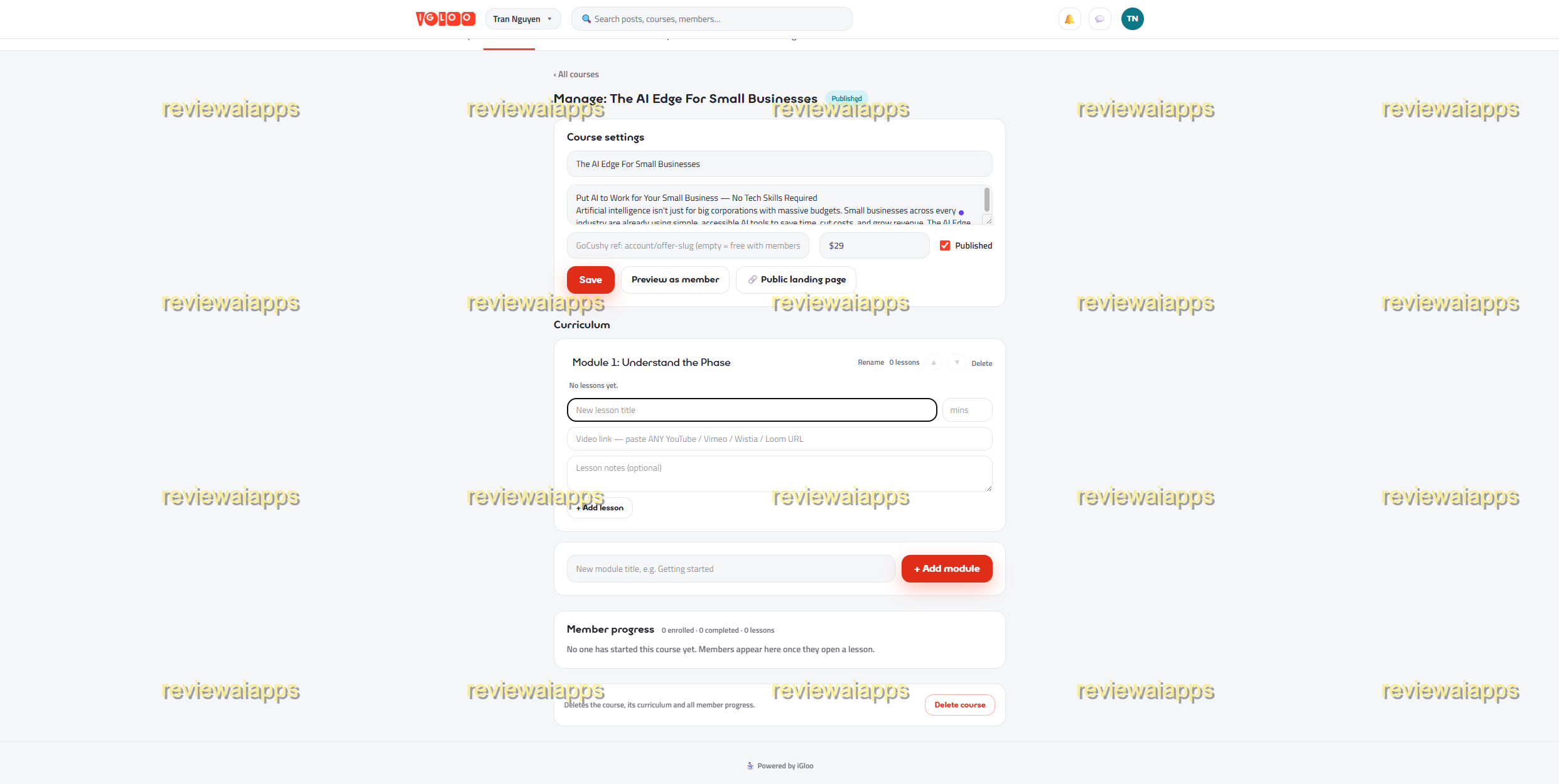
Then you add modules, and inside each module, you add lessons, with a title, runtime in minutes, optional video link and optional written notes.
Video is embed only. Just paste a YouTube, Vimeo, Wistia, or Loom URL and it becomes a player. iGloo doesn't host videos, so you'll need to store files elsewhere. Most people that is an unlisted YouTube upload which is a workflow inconvenience not a cost but worth knowing before you buy.
Each course has 3 possible commercial states and this is really flexible. The course is included free with community membership and the product reference field is left blank, making it a retention asset. Include a product reference, and note that it is a paid product that members purchase separately. Or gate it behind an Expedition level so it only unlocks for active members, making your library of courses into an engagement mechanism as opposed to a static shelf.
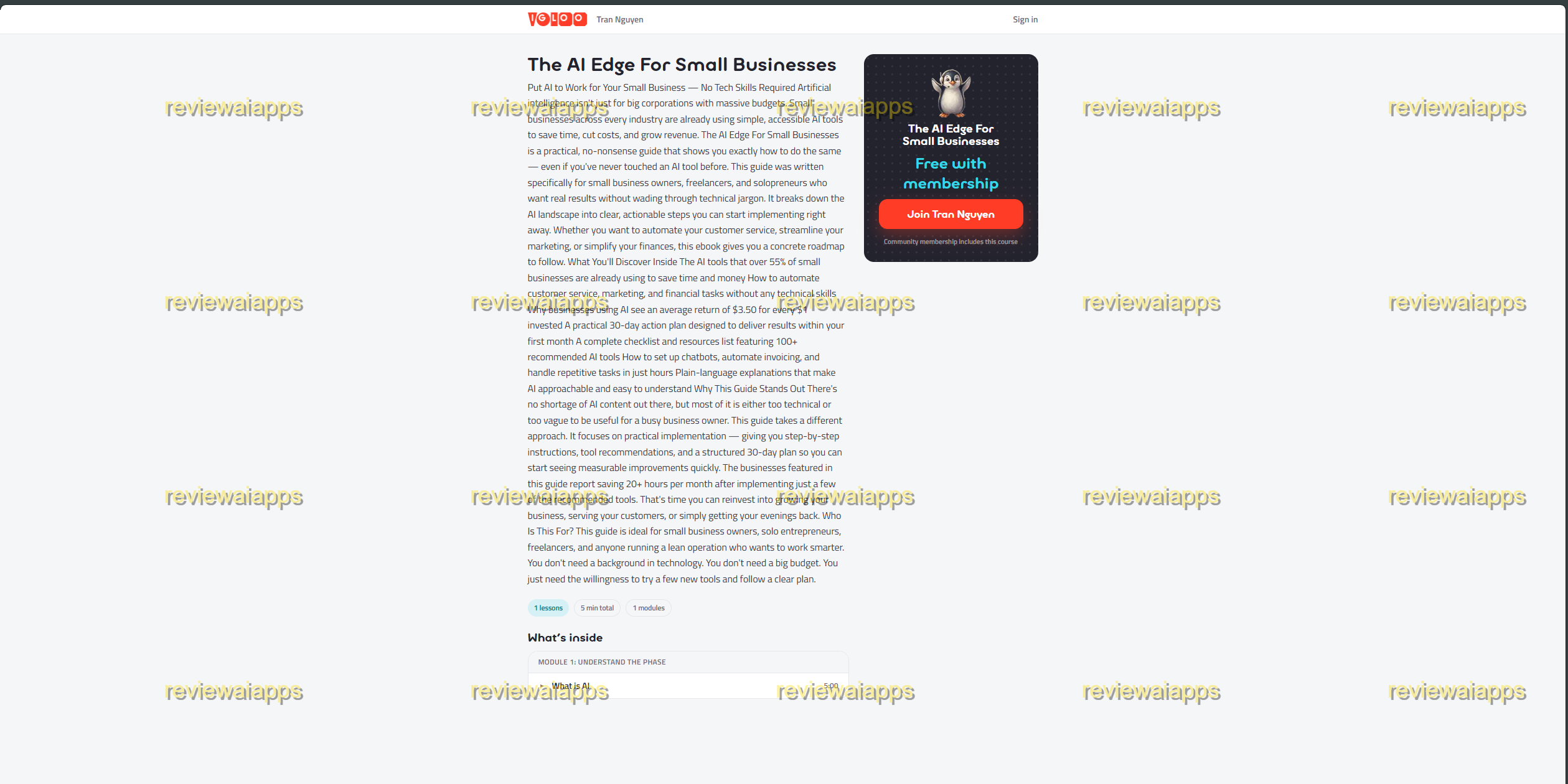
Every paid course has a public landing page. A visitor who is logged out sees the course title, the full description, the module and lesson breakdown, the total runtime, and a join or buy panel. It renders cleanly and looks like an actual sales asset, not an afterthought. A usable public sales page per course is a nice touch when you’re selling a thirty-seven dollar product.
It also has basic progress tracking. The course manager displays the number of enrolled members, the number of lessons completed and who has started. It is not analytics in any real sense, but it is there.
One word of caution from hands-on testing. If you enter a value in the display price field and leave the product reference blank, the course still gets published and the public page displays the course as free with membership. This price is ignored, without warning. It’s easy to make and easy to overlook, so check your public page after posting something paid.
Connect your checkout
iGloo does not handle payments. Instead it provides access through signals from an external cart.
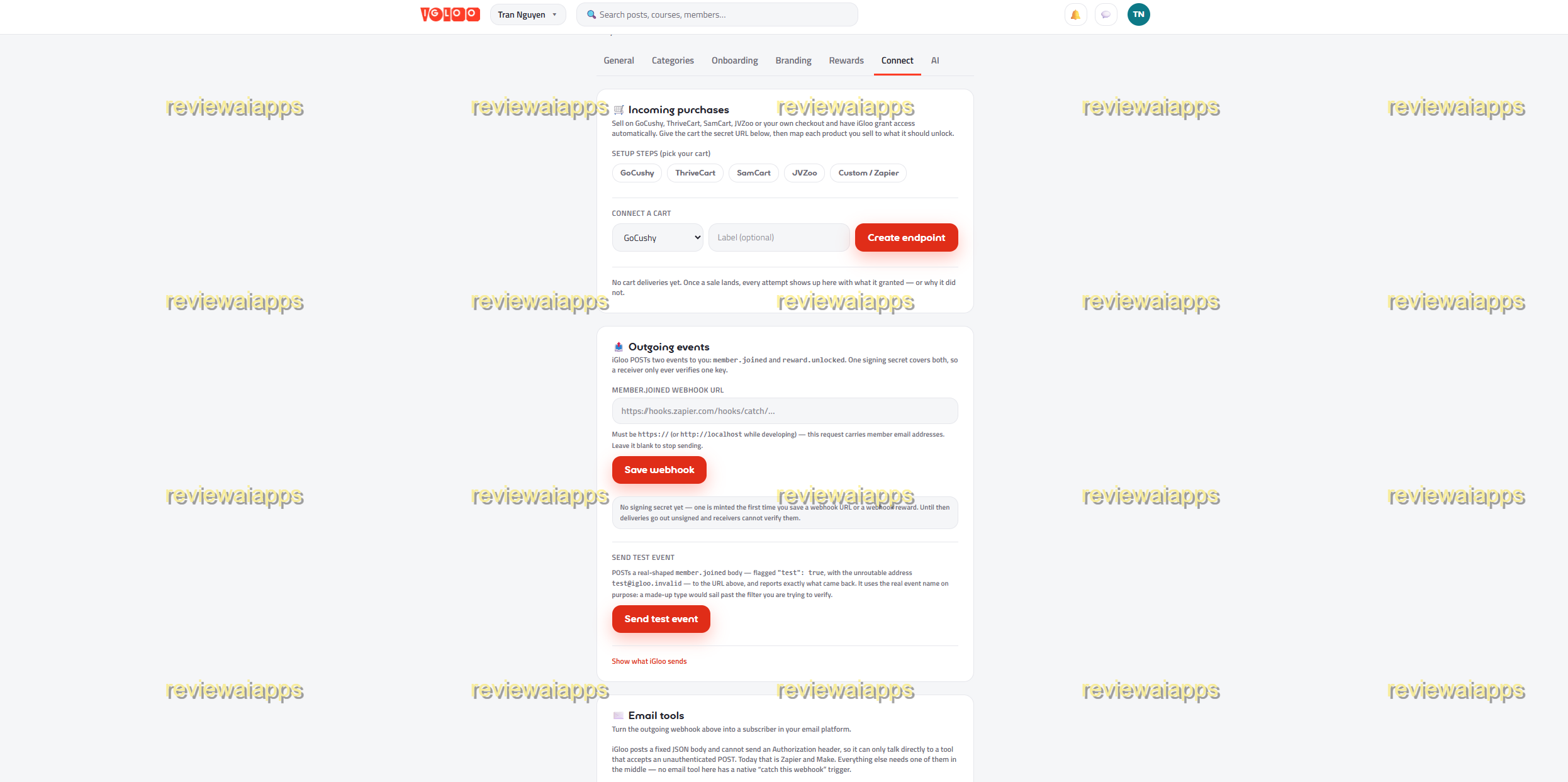
Connect settings panel supports GoCushy, ThriveCart, SamCart, JVZoo or custom endpoint using Zapier. You create a secret endpoint URL, you give that to your cart, and you map each product you sell to whatever it should unlock. Every attempt is shown in a delivery log, with what it granted, or why it failed. Refunds automatically retract access, which is a proper implementation of something a surprising number of cheap platforms do badly.
But there is an asymmetry to note. Five carts are able to provide access, but the course creation form has exactly one product reference field and it is labeled for GoCushy. GoCushy is a checkout system built by Sam Bakker. So while access-granting is really cart-agnostic, native per-course selling points at the vendor’s own product.
That's not hidden and it's not unusual for a software founder to create products that work best when used together. But it should be a part of your thinking about what you’re really buying into.
The AI Budget Nobody Talks About In The Demo
This is the most important finding in this review and you won't find it on the sales page.
iGloo has two separate artificial intelligence systems and the marketing allows the virtue of the first to carry the second.
The first one is the demo one. You connect your own Claude or ChatGPT account via MCP, and run the platform by typing. That’s all part of your AI subscription. iGloo doesn’t charge you, doesn’t sell you credits, and can’t jack the price later. That is true, and that is the real breakthrough here:
The second is AI for members: a concierge for member questions, an Operator within the app, and a staff Assistant. They run on iGloo’s infrastructure, not yours. And inside the AI settings panel there is a usage meter that tells you exactly what you receive.
200,000 tokens per month, shared across all three systems, resetting on the first of the month.
The same panel explains that each question resends your community context, so one question costs about four to five thousand tokens. Do the math and that’s somewhere between forty and forty-five member questions for your whole community in the monthly budget. The panel also notes that individual members are allowed thirty questions a day, so one eager member can burn up most of a month’s allotment in a single afternoon. “iGloo itself states this.
To be fair about how it degrades: iGloo deals with running out with honesty. Instead of spending the money silently beyond the limit it doesn't call the model, the concierge falls back on answering from your existing community content, and the Assistant tells you why a button didn't work. No overspending behind your back. That's better engineering than most of this market delivers.
But budget and allowance controls are not self-service. You contact the iGloo team and ask to raise them. Which means you’re emailing back and forth with a vendor to negotiate your AI capacity, rather than actually buying more at scale.
Here is a plain answer. The owner side AI is uncapped and impressive. The AI facing the member is a demonstration allowance, not an operating budget. If you’re pitching members that they’ll get an AI concierge, know what you’re actually selling them.
The Upsell Funnel and Pricing
There’s no bundle deal on this launch. There is one buying path, buy the front end then accept or decline each upsell as you come to it.
Front End, one time, $37. | The platform and the full core training. One community. Your cart opens for buyers, closes it out with refunds. The community has iGloo branding. |
Upsell One $67 One Time. | PRO. Includes your own logo, your own custom domain, three communities instead of one and training on growth, retention and monetization. |
Upsell Two hundred and ninety-five dollars one time. | Named iGloo MAX. Raising the cap to 10 communities. Adding the prepaid AI budget that powers the member-facing concierge and the in-app Operator. Adding access to a buyers-only community. |
Upsell Three, four hundred and ninety-five dollars one time. | The Agency level. Adds client rights to build and run communities for other businesses, ten communities, and a three-module playbook to run client rooms. |
The entire funnel comes to seven hundred and ninety-four dollars. Nothing rebills in it. No matter which plan you choose, iGloo has no monthly fees.
Two honest comments about that structure.
First, the real price of entry is not thirty-seven dollars. Your community is sitting on iGloo branding. On the front end. If you are charging people to join something, running it under someone else’s logo devalues the price you are asking for. And so the functional floor of somebody selling access is the front end plus the first upsell which is one hundred and four dollars.
The third tier is the member-facing AI, the most compelling piece of the pitch to your members. There is no member concierge at the front end at all.
What It Doesn't Do
This list is published by the vendor, so it’s easy to be accurate.
No video hosting, embeds only please.
No built-in email auto-responder.
There is no bulk import of members from a spreadsheet so to populate a community you need to either invite people one by one or drive them through your cart.
No one click export everything.
No native iOS or Android app, mobile is a progressive web app.
And no AI that posts without supervision which is a design decision not a gap .
Two of them are more weighty than the list gives them.
The limit on the autoresponder is more restrictive than it looks. iGloo can push new members to your email tool using webhook, but it uses a fixed JSON body and cannot include an authorization header. In practice it can only talk directly to something that accepts an unauthenticated POST, which these days is Zapier or Make. One of these in the middle is required for Mailchimp, ActiveCampaign and Kit. So to really get members into your list you’ll need a paid automation subscription.
Mobile is more important to community software than most products. Push notifications and frictionless phone experience fuel a paid community engagement. Competitors ship native applications. There is a real gap here for a progressive web app – not a cosmetic gap.
The Concerns That Are Worth Being Honest About
The structural question is the pricing model of a one-time charge. In the long run, running hosted communities is expensive because storage, notifications, uptime and member data all scale with your success while the payment was made once. The reason why the established players are charging around eighty-nine to ninety-nine dollars a month. Economics is economics, $37 once doesn't change that, it just passes the risk to the buyer. The realistic outcomes are a later migration to paid plans, some degradation in service or a practical ceiling on what lifetime turns out to mean.
That risk is exacerbated by the missing export. You’re bringing an audience to a platform that you can’t bulk populate and can’t bulk leave. When the direction of the platform changes, it is difficult to get your members out.
There is also the technical prerequisite that the price tag conceals. The headline feature requires an active paid Claude or ChatGPT subscription, and the willingness to paste a JSON configuration with an API key into your AI client. For a good portion of buyers in this price range, that’s five minutes for someone with a tool and a wall. iGloo is this one payment, and never another subscription. It is quietly untrue about the setup it needs. Twelve months of an AI plan costs more than the entire funnel.
Lastly, there is no independent track record yet. The only evidence of use at launch is from the vendor’s own communities. The architecture is documented, the tools are real. But no one outside the company has actually stress tested it under load.
Who Is This Really For
If you have an audience somewhere you don’t own, like a Facebook group or a follower count, and you want to move them to something that is yours, without committing to a hundred dollars a month first, that makes sense. It makes sense if you are already selling a course and are paying monthly for a platform that does less than you expected. If you do client work it fits. Community setup keeps coming up on calls in which case the agency tier is the relevant part. And it works especially well if you’re already running your working day through Claude or ChatGPT.
If you have a community established elsewhere with revenue, this doesn’t work. Don’t move that into this on day 1. It does not fit if you want native mobile apps, built-in video hosting or serious analytics. And that doesn’t make sense if you aren’t paying for an AI assistant and don’t intend to, because then you’d be getting a competent but unremarkable community platform and leaving the distinctive part on the shelf.
Verdict
iGloo App AI is a real product with a real idea. The MCP layer isn’t selling vapor: 30 documented tools, a public manifest, working webhooks and building a course by typing really works. Clean interface, usable public course pages, proper access revocation for refunds, and the vendor is more honest about limitations than almost anyone launching in this space.
The difference between product and pitch is one of size, not substance. The member-side AI is budgeted for demonstration, not operation. The promise of no subscriptions relies on subscriptions you purchase elsewhere. And the one-time price on perpetually-hosted software is a question no one in this category has answered well.
Buy it for something new and small where the downside is a small one time cost and the upside is a community platform you can drive by talking to it. If you are charging for access, take the front end plus the first upsell. Don’t promise the AI concierge, test it as a feature. And keep your email list somewhere you own, because that is the asset that will survive anything that happens to any platform.
✅ Runs on your own Claude or ChatGPT plan — iGloo sells you no credits
✅ Build a full course by typing: modules, lessons, drip schedule, published
✅ Public sales page for every paid course, with a join and buy panel
✅ Connect GoCushy, ThriveCart, SamCart or JVZoo — refunds pull access back automatically
✅ One-time pricing all the way through the funnel — nothing rebills
🎁 VISIT MY BONUS PAGE 🎯