

CineClaw Review
Can This AI Show Creator Really Turn One Prompt Into a Finished Long-Form Video?
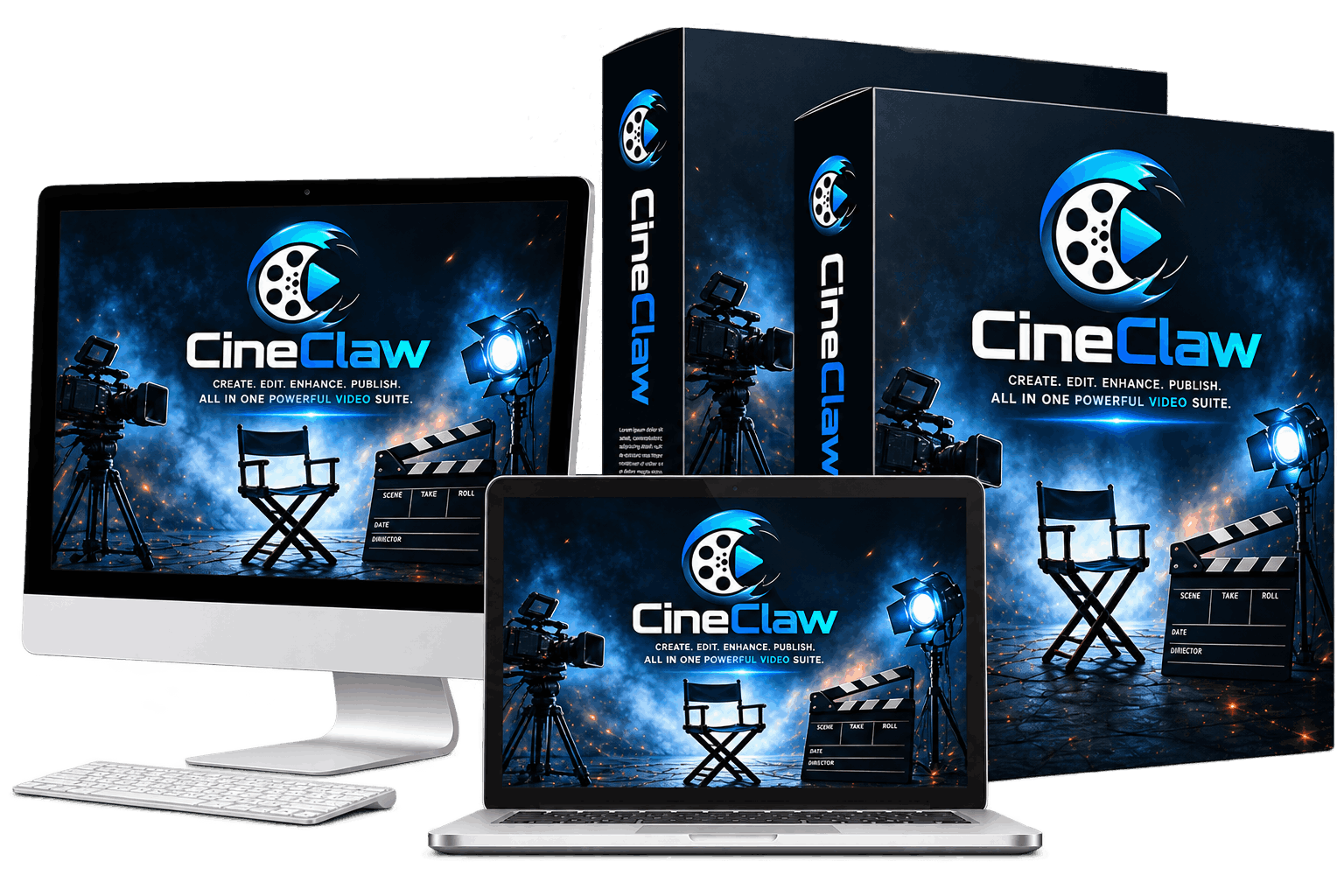
Every few months, one more AI video tool is released promising to replace the camera crew, the editor and the scriptwriter, all at the same time. Most of them are still only five to fifteen second clips, so you have to string a dozen of them together before you have anything watchable.
Team Black Belt and vendor Art Flair’s CineClaw aims higher: videos of 10, 30 or even 60+ minutes, generated from a single written prompt, with script, narration, visuals, captions and YouTube-ready metadata. It kicks off on September 19, 2026, and runs through September 24, and pitches itself as a “AI Show Creator” capable of producing anything from a faceless YouTube explainer to a multi-episode cinematic series.
That's a big claim, so before we wrote a word of hype or a word of criticism, we went and used it. This CineClaw review is based on the real JV documentation, the live sales page copy and a hands-on walkthrough of the member dashboard itself including generating a real video from a real prompt. Next we will look at the purchase paths, what the tool really does behind the interface, and where the marketing holds up and where it does not.
The Buying Path & Upsell Funnel
CineClaw is not a simple front-end-plus-bundle structure. It is a single sequential funnel. So, here is what a buyer actually goes through, tier by tier, and what each one unlocks.
The front end gets you into CineClaw itself at an introductory price of $17 (the live sales page shows a rotating launch price closer to $12 to $17 during the early bird window, before climbing as the cart stays open). This is the core product: prompt to video generation, credit based studio dashboard, AI scriptwriting and voiceover, and the ability to promote or publish anything you create with no restriction on niche. The sales page presents this as a tier with a 30-day money-back guaranty.
The first upgrade, CineClaw Infinite, costs $147, and promises to “remove the practical limits of the front end: unlimited clicks, unlimited campaigns, and unlimited “1-click followers” for any distribution features that the base plan gates.” The vendor's own documentation shows that this tier has a longer 365-day guaranty window.
CineClaw DFY Pack is $297 and a shift from software features to done-for-you assets: ready-made evergreen affiliate campaigns, automated campaign templates, CPA campaign sets, social media promos, email sequences, engagement posts, squeeze pages, and traffic resources. This tier essentially gives you pre-made marketing materials to plug into whatever you’re promoting with videos made by CineClaw.
The CineClaw Automation, \(39, covers almost the exact same territory as the DFY Pack: automated campaigns, evergreen affiliate set-ups, social and email templates. If you’re looking at value, note that there’s significant overlap between this tier and the one above, with nearly interchangeable bullet points despite the \)258 price difference.
CineClaw 10x, also priced at $39, is a different ballgame. It allows you to build and sell done-for-you websites, blogs, stores, sales copy, social posts, articles, and SEO content on behalf of clients, along with creating an AI image from any keyword and translating content into 35 languages. It’s essentially an agency-in-a-box add-on, that’s meant to resell services based on CineClaw’s output, not just use the tool itself.
CineClaw Platinum, $67, is a reseller rights tier. Resell CineClaw and keep 100 percent of the profit on the funnel.
CineClaw Diamond, $297, is almost a clone of CineClaw 10x, with a similar list of features, word for word: done-for-you websites, sales copy, social content, articles, SEO content, keyword-to-image conversion, and translation in 35 languages, again with the hook of starting an agency. This list is nearly identical to OTO4, so before assuming this is meaningfully different than the cheaper 10x option, buyers should read the actual sales page for this tier.
Guaranty terms are not uniform across the funnel. The main $17 offer has a 30-day guaranty according to the sales page, some upsells have 365 days, and others don't mention a guaranty. Don’t assume that one policy covers the whole purchase, but check the terms of the guaranty on each individual order page.
What CineClaw Really Is
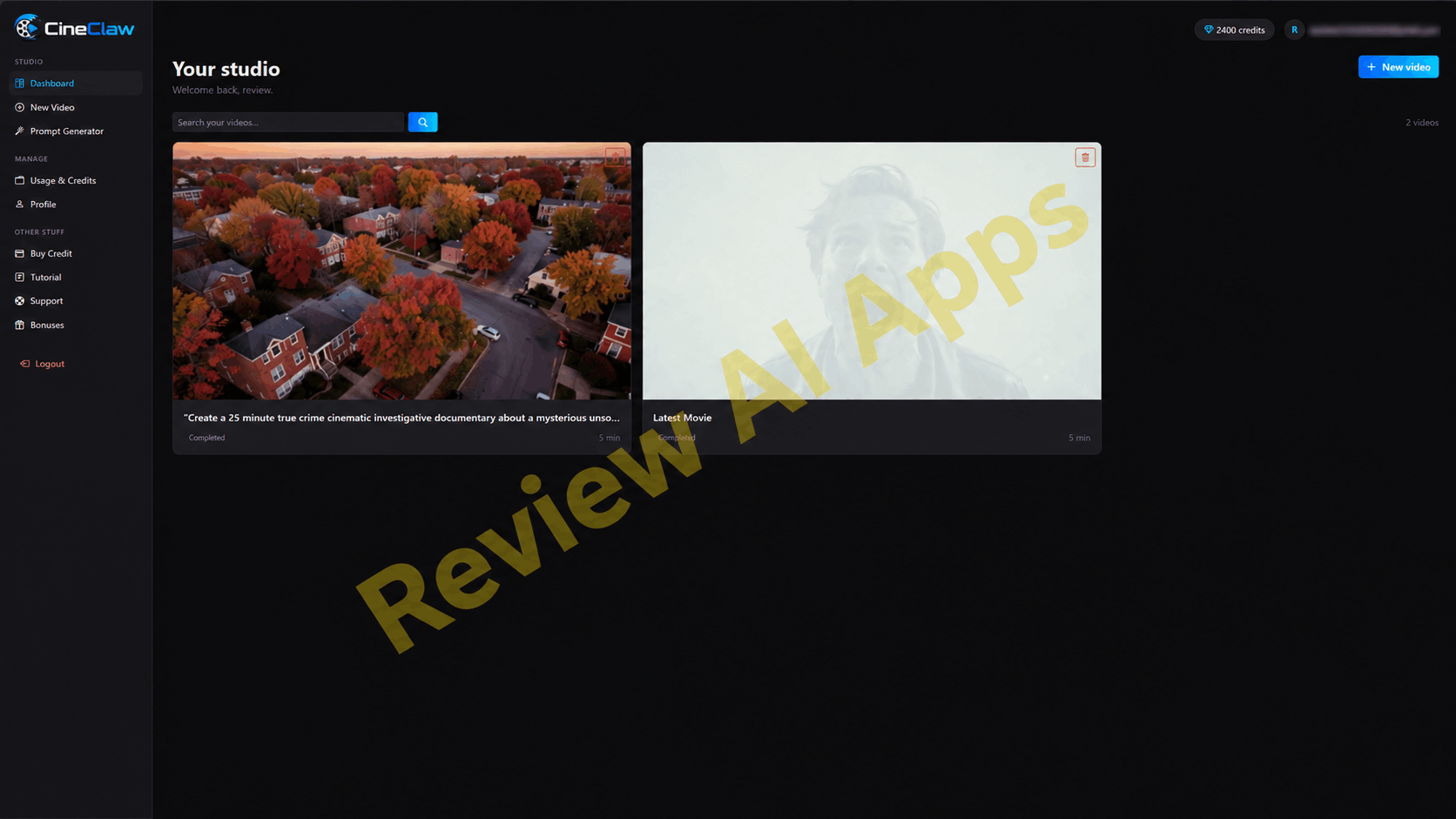
Strip away the launch-page lingo, and CineClaw is a browser-based studio that creates long-form, narrated video content from a written prompt.
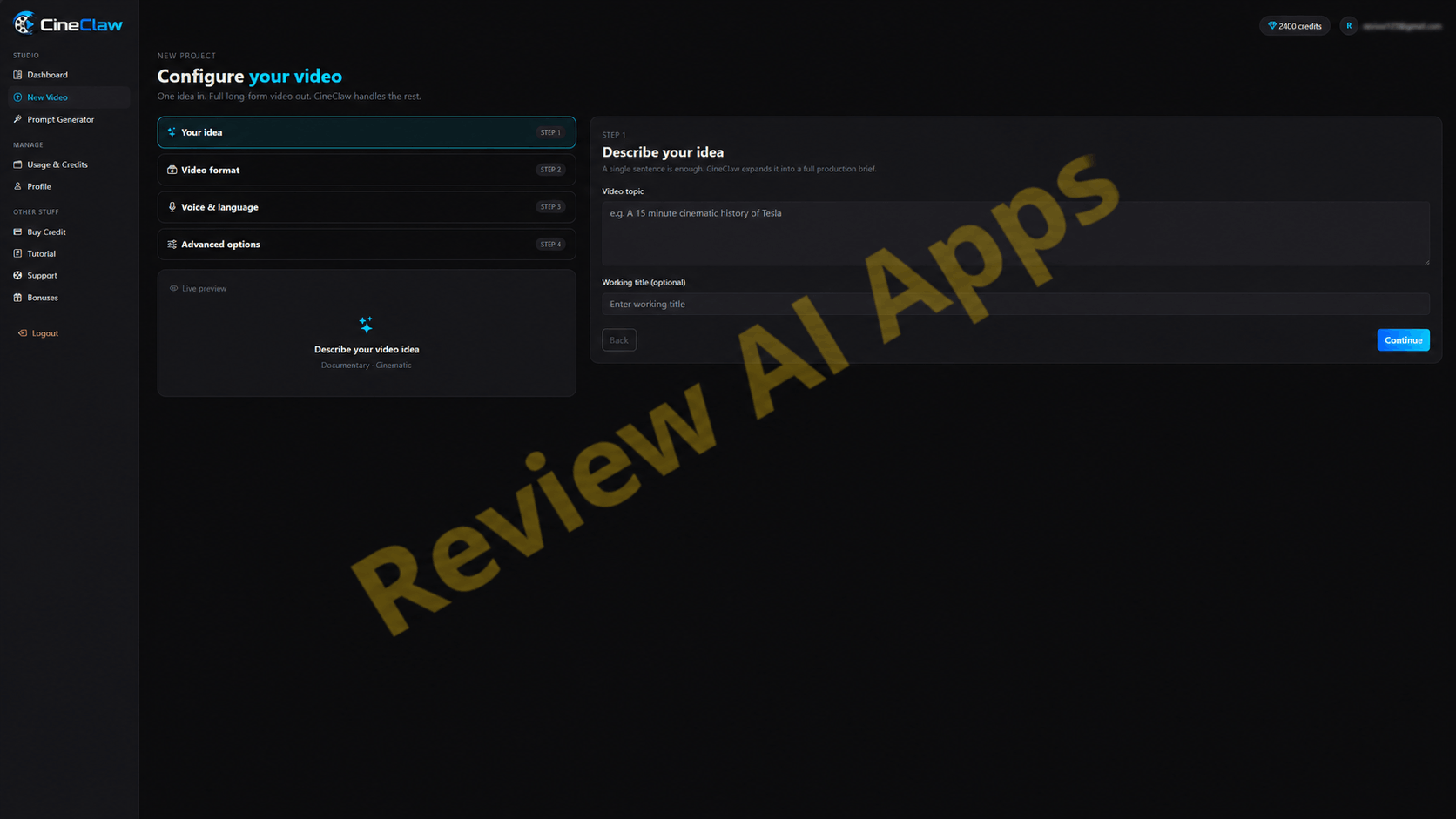
You give the system a sentence or two about the idea and it translates it into a full production brief: a script, a scene-by-scene outline, an AI voiceover, captions, a thumbnail, and search-optimized metadata for platforms like YouTube.
It is built to work without installing anything, running entirely from a dashboard, and the finished output is delivered at 1080p.
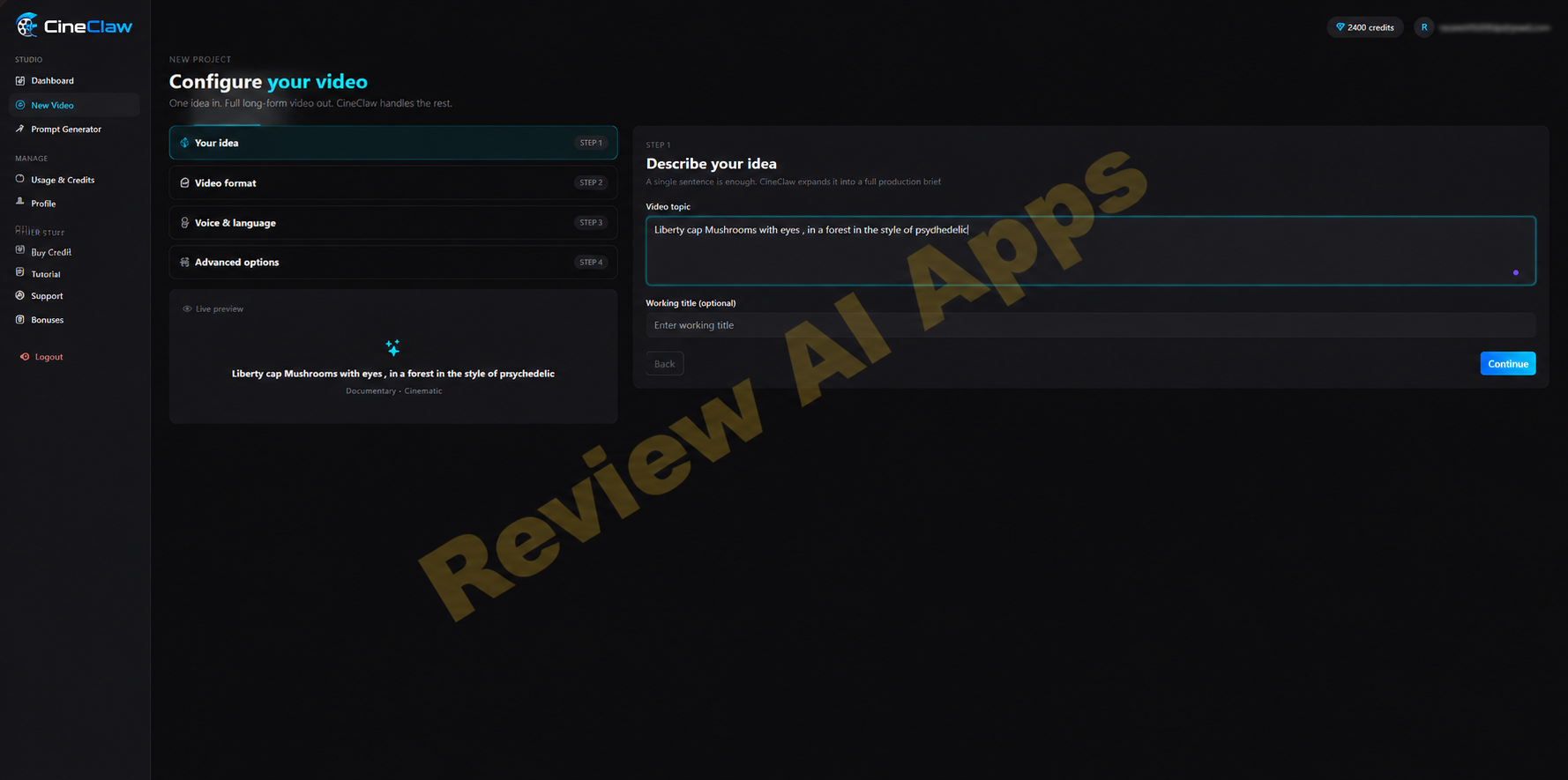
This is powered by a nice clean four step flow wizard. Step one: your video topic and an optional working title. Then you pick a video format — documentary, educational, faceless YouTube, explainer, etc. — and a visual style: cinematic, bright and modern, minimal.
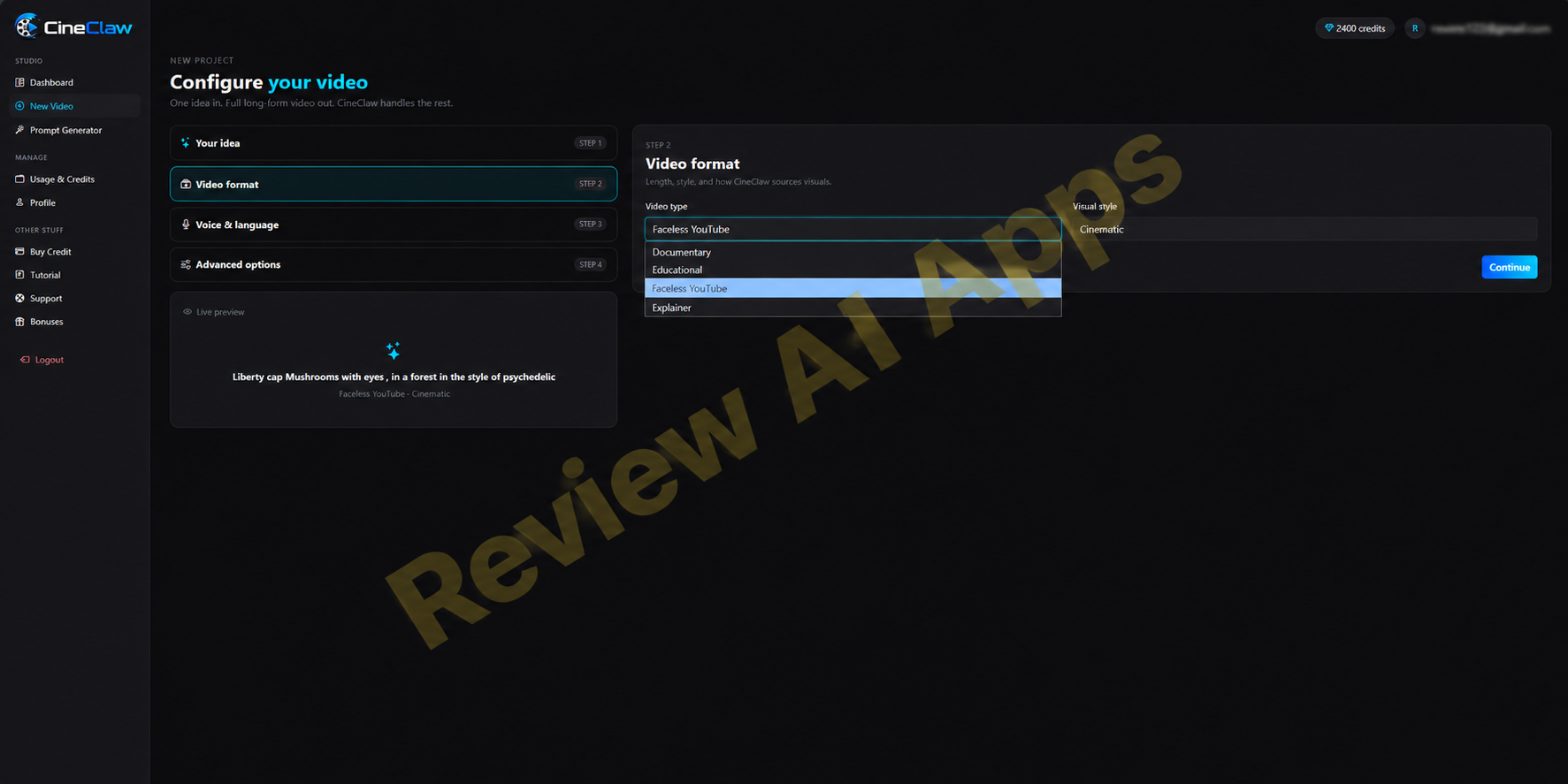
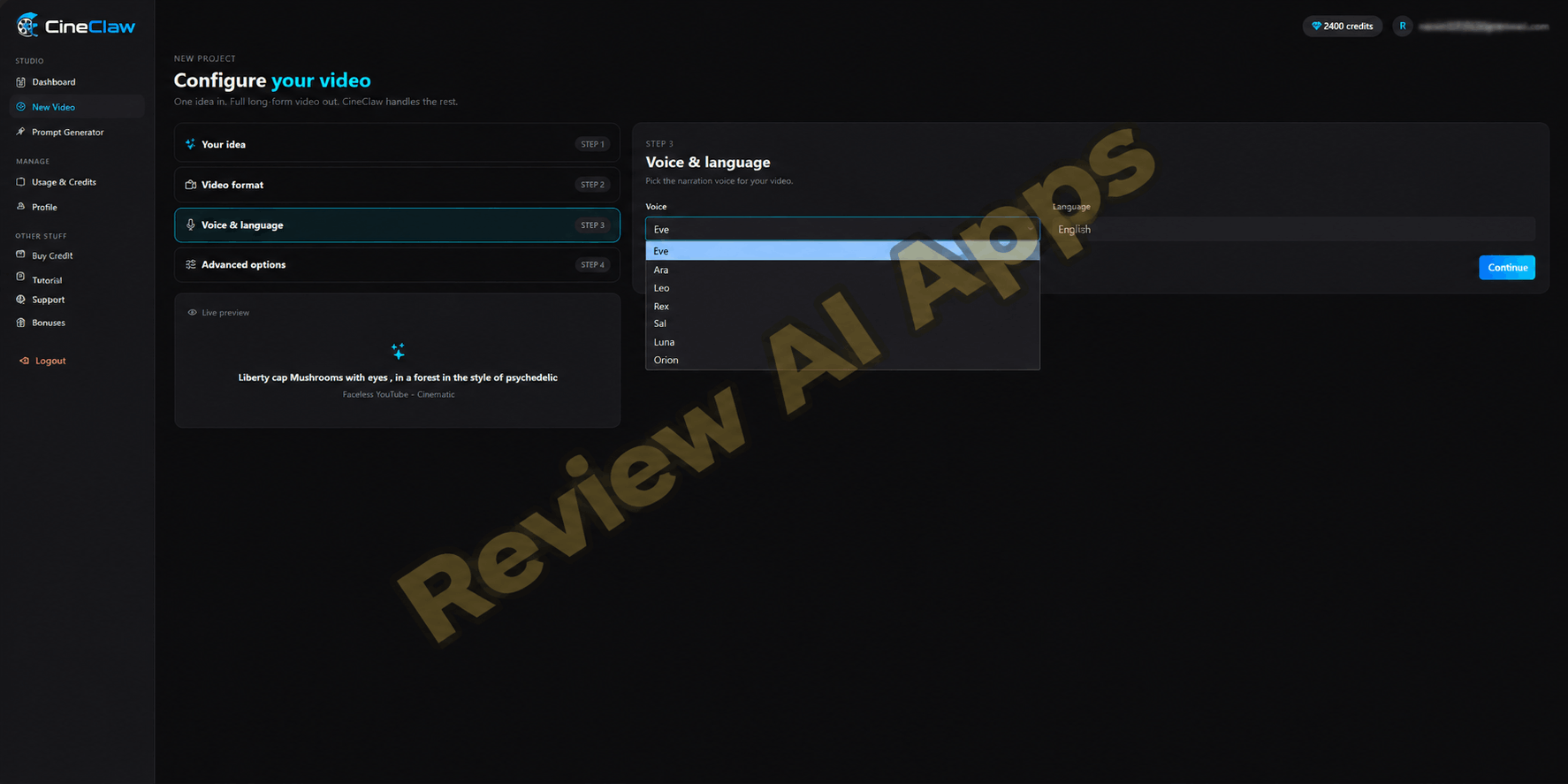
Step Three allows you to choose a voice from a selection of named voices and a language for the narration.
Step four unlocks advanced settings: a target audience field, a video objective field with autosuggested tags, and toggles for subtitles, YouTube SEO generation, an intro, an outro, thumbnail creation and a “use premium stock” option. From there, you press one button to start the render.
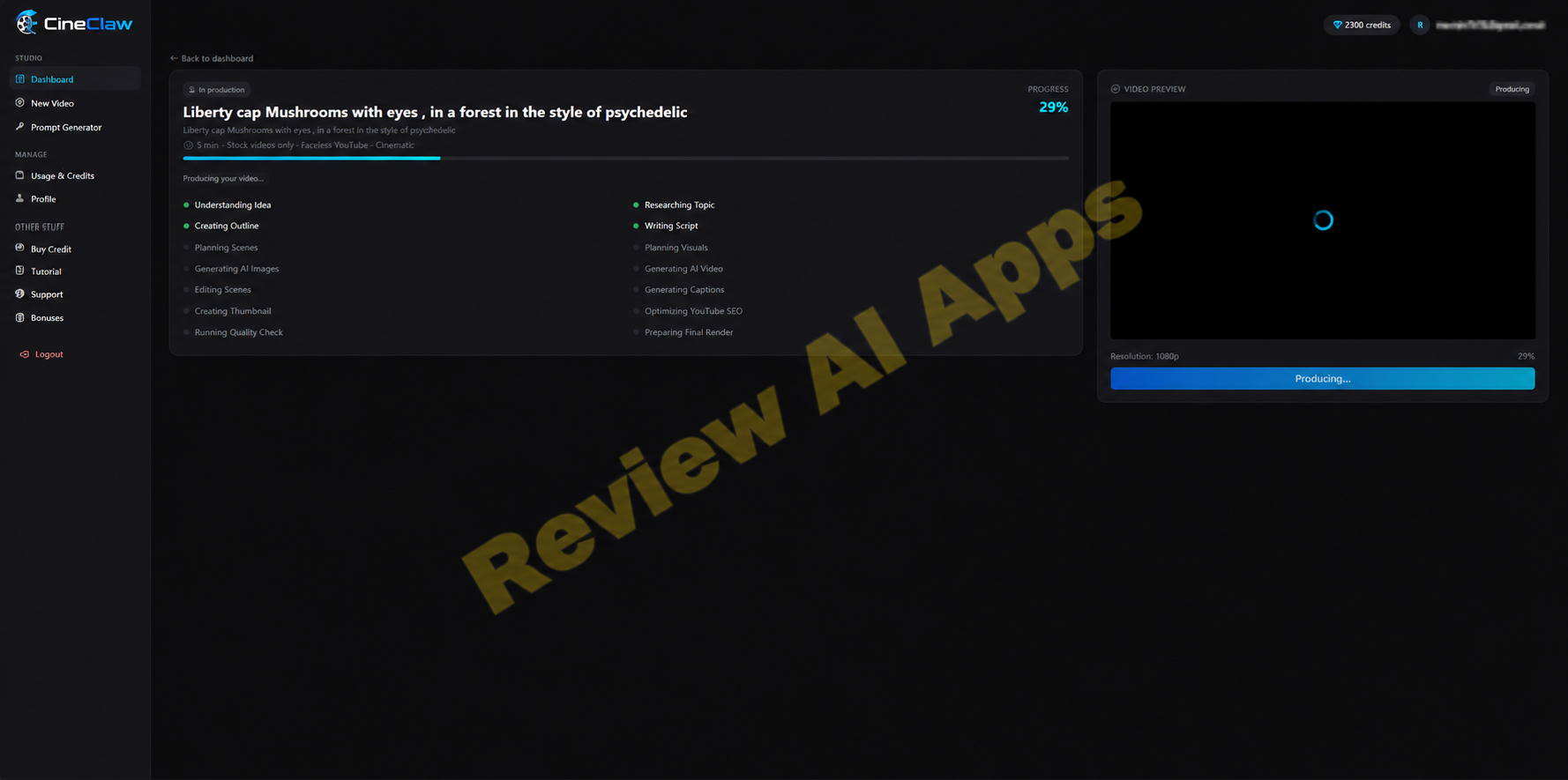
Clicking generate, the system works through a visible fourteen-step production checklist: understanding the idea, researching the topic, creating an outline, writing the script, planning scenes, planning visuals, generating AI images, generating AI video, editing scenes, generating captions, optimizing YouTube SEO, creating a thumbnail, running a quality check, and preparing the final render.
In our test, a video went through this pipeline and was ready in about five to ten minutes, which matched the in app messaging.
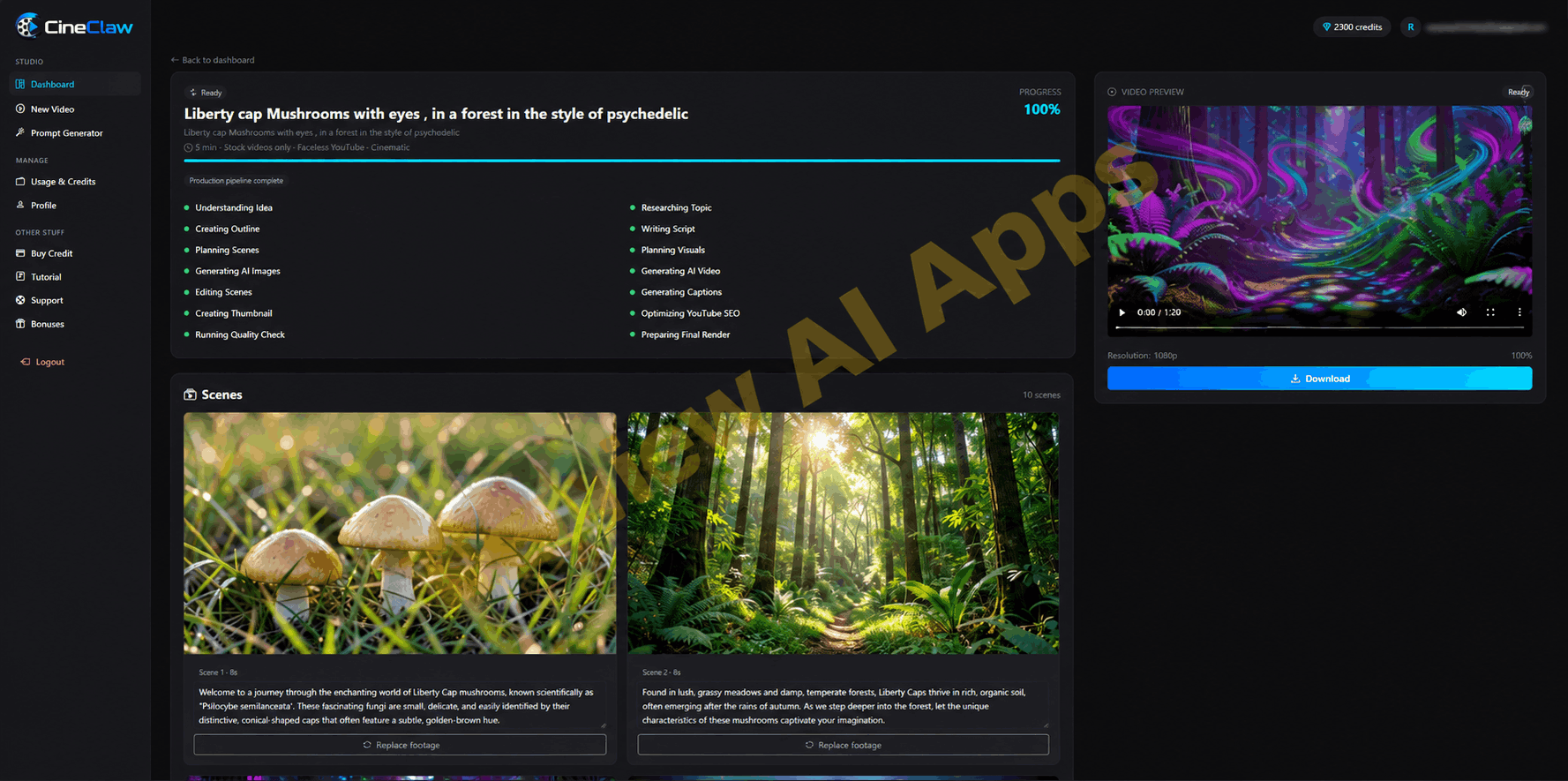
The dashboard itself, “Your Studio,” is built around a simple project library, not something overwhelming.
There are some sample projects already in the library, which are finished playable videos, including an example investigative documentary done in a true-crime style, and a shorter demo video, marked complete at around five minutes each, to give a sense of the kind of output the tool is aimed at.
The side nav is divided into 3 simple groups: Studio for the dashboard, creating new videos, and a prompt generator tool for those who want help with their first prompt; Manage for usage, credit history, and account profile; and “Other Stuff” where you can purchase extra credits, access a tutorial, get support, and find bundled bonuses. None of it requires technical knowledge to navigate, which does match the sales page’s claim of a user-friendly interface.
The feature side is really broad in terms of voice and language choices. The voiceover step has a choice of named AI voices and the language selector supports dozens of languages, backing up the claims on the sales page of 70+ language support for narration and 75+ voice options available. The tool is also built for multi-episode projects, pitched on the sales page as being able to turn one prompt into a whole “season” of related videos instead of one-off pieces, aligning with the “AI Show Creator” branding used throughout the launch materials.
Visuals: How They Are Really Made
And this is the part of CineClaw that the sales page glosses over, and it’s enough to spell out. In the dashboard, the video we created was labeled “Stock videos only” and when we clicked into the individual scenes, the footage behind them was traced back to Pexels, a free stock media library, and matched to the script line for each scene by a percentage-based relevance score. If you click "Replace footage" on any scene, it opens a search tool that returns stock photo and video alternatives from that same library—not new AI-generated renders.
It does not mean the claims of the AI generation are false. Another still image from the same project, hosted on Runware, a genuine AI image-generation backend, showed something that no stock photo library could ever offer: mushrooms with actual eyes generated directly from the weird, precise prompt we entered. And that confirms that CineClaw does do real AI image synthesis somewhere in the pipeline. In practice, that means that the final long-form “video” you get by default looks less like a dedicated AI video model that generates every frame of moving video from scratch, and more like an AI-scripted, AI-voiced production assembled from real stock footage. If you’re expecting to punch in a sentence, and get back a fully synthetic motion from a pure text-to-video generator, then you should temper those expectations. CineClaw is doing real automation work, just not the kind that its most dramatic sales copy suggests.
The Credit System No One Tells You About on the Sales Page
There is no mention of a usage-based credit system in the JV documentation or sales page, yet the dashboard is powered by one. A new account has 2,400 credits, and in our testing, one five minute video used 100 credits, so that’s about 24 videos before you have to buy more through the “Buy Credit” menu. This is a big point for anyone whose buying decision is based on lines like “unlimited campaigns,” “unlimited sales,” or “60 seconds a day” meaning unlimited output. It’s actually about a limitation by credit balance, and a necessity of continuous credit purchases to keep using, which is similar to a soft subscription even if the core offer is marketed as a one-time payment.
That tension is more than suggested. The FAQ on the sales page itself clearly states that the company “reserves the right to raise the price… and introduce a monthly fee” after the launch window. That, along with a credit system that already metered usage, suggests the well-trodden pattern in this category, where a “pay once, use forever” launch price quietly morphs into recurring costs after the promo period.
Features That Really Work
To be fair to the product some of the more down-to-earth claims stand up in real-world use. The AI voiceover system provides a real choice of named voices and language options and the script-to-narration pipeline works without any recording or editing skill. Automated caption generation, thumbnail creation, and YouTube SEO metadata (titles, descriptions, and tags) all seemed to be working steps in the production pipeline, not empty bullet points. With your purchase you get a commercial license, so you can use the output for client work or resale without any additional licensing fee. And the “works on any device, nothing to install” claim is accurate: The whole tool runs through a browser-based dashboard, with no software download necessary.
The five bundled bonuses attached to the core purchase are also concrete rather than vague: a set of one hundred ready-made website prompts, a freelance quick-start guide aimed at landing a first paying client, a website-flipping blueprint, a report on high-profit niches for 2026, and a client outreach swipe file with email and outreach templates. The vendor lists a combined value of $8,029 for these, which, like most bundled bonus values in this launch category, should be treated as a marketing figure rather than an appraised price.
Where Marketing Over-Sells It
The claim most in need of a reality check is the central pitch that CineClaw solves “the AI clip problem” by generating complete cinematic video from a single prompt without requiring stock footage. As mentioned above, the default generation mode uses real stock media for the moving-video layer, which goes against the idea of a pure AI video engine replacing a whole production team.
The income claims scattered around the sales page – $2,000 to $3,000 a month from YouTube, as much as $5,000 per episode from podcast advertising, and $20,000 to $30,000-plus from documentary projects – come with no case studies, user data or typical-results disclaimer. These are illustrative ceiling numbers, not realistic expectations for someone picking up the tool for the first time, and should be treated as such.
The testimonials on the sales page are written in the pre-launch JVZoo style. Named people giving generic praise, with no linked channels, companies or verifiable outcomes attached. This is typical for this type of launch and is not evidence of something fabricated. But it is also not independently verifiable social proof.
Finally, the reference pricing they use to frame the launch discount of a “$199 per month” or “$997 standard price” that is “regular” doesn’t have any independent verification behind it. There is no sales history to prove that CineClaw actually sells at those figures elsewhere, nor is there a comparable non-launch version of it.
CineClaw Review: Who It Really Works For
CineClaw is best for someone who wants to create narrated, long-form video content such as faceless YouTube channels, explainer content, documentary-style videos or course material without having to write scripts, record voiceovers or learn video editing software. If you’re already stitching together stock footage, a script and some sort of text-to-speech tool in your workflow, then CineClaw pretty much automates and consolidates that into one dashboard. It’s a legitimate time saver, even taking the stock-footage caveat into consideration.
It is a weaker fit for anyone who is specifically looking for a pure AI video generator that outputs original, fully synthetic motion in every scene because that’s not what the default pipeline provides. And with the credit system and the vendor admitting that pricing could change post-launch, it's also something to tread carefully on if your buying decision hinges heavily on the income projections or on the assumption that a one-time payment means unlimited generation forever.
CineClaw Review: Quick Pros & Cons
Automates scriptwriting, AI voiceover, captioning, and YouTube SEO metadata, all in a single browser-based dashboard, with no software to install
Real AI image generation confirmed behind the scenes, not just marketing speak
Simple four step wizard to create, no editing or technical knowledge required
Five concrete, non-vague bonuses bundled with the front-end purchase and a commercial license included
By default, video is generated from matched stock footage, not fully AI-generated motion. This is not clear on the sales page
Credit based usage system is not disclosed in the marketing, and is in direct conflict with "unlimited" language used throughout the sales copy
Vendor's own FAQ concedes pricing could shift to monthly fee post launch, undercutting "pay once" pitch
Income claims and testimonials are made without any supporting data or context of typical results
Many OTOs in the funnel have similar feature lists but wildly different prices so each upgrade should be evaluated on its own sales page
The bottom line - End of My CineClaw Review
CineClaw is a functional, genuinely useful tool for quickly creating scripted, narrated, long-form video content with real automation across scriptwriting, voiceover, captioning and SEO metadata, as well as authentic AI image generation running behind the scenes.
Where it doesn’t quite deliver with its own marketing is in the space between “AI creates your whole video” and what actually happens by default, which is AI-powered scripting and narration with matched stock footage, plus an undisclosed credit system that puts a real cap on the “unlimited” language used all over the sales copy.
Buyers who know what they’re getting, an AI-assisted production tool (not a text to video generator), and who budget for credits beyond the initial allotment, will probably find real value here at the front-end price point. Anyone tempted by the income promises alone or the idea of fully AI generated cinematic footage ought to read past the headline copy first.
This CineClaw review boils down to a product that works as an efficient video-assembly tool, sold with more ambition in its pitch than its default output currently delivers.